
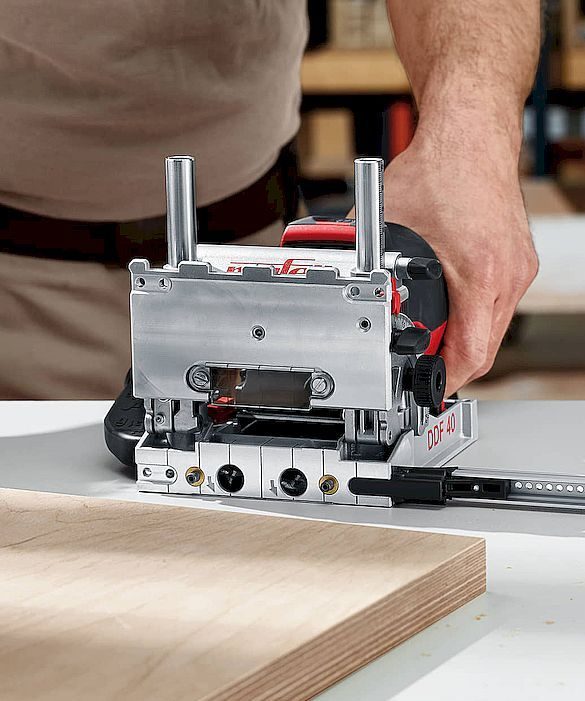
Precision doweling for the professional woodworker and dedicated hobbyist.
If you’ve ever wanted the accuracy of a drill press with the speed and freedom of a handheld tool, the Mafell DuoDoweler DDF 40 sits in a category of its own. It’s a tool that doesn’t try to replace every joinery method in the shop, but what it does, it does exceptionally well, and with a level of refinement that’s hard to ignore.
Manufacturer: Mafell
Model: DuoDoweler DDF 40
Price: $1,864.00
Warranty: 1 Year
Source: Ultimatetools.ca
KEY FEATURES:
Motor: 1.2 hp
Strokes per minute: 8,000
Drill bit sizes: 3 mm to 12.2 mm
Cutting depth: 40mm
Weight: 2.8 kg
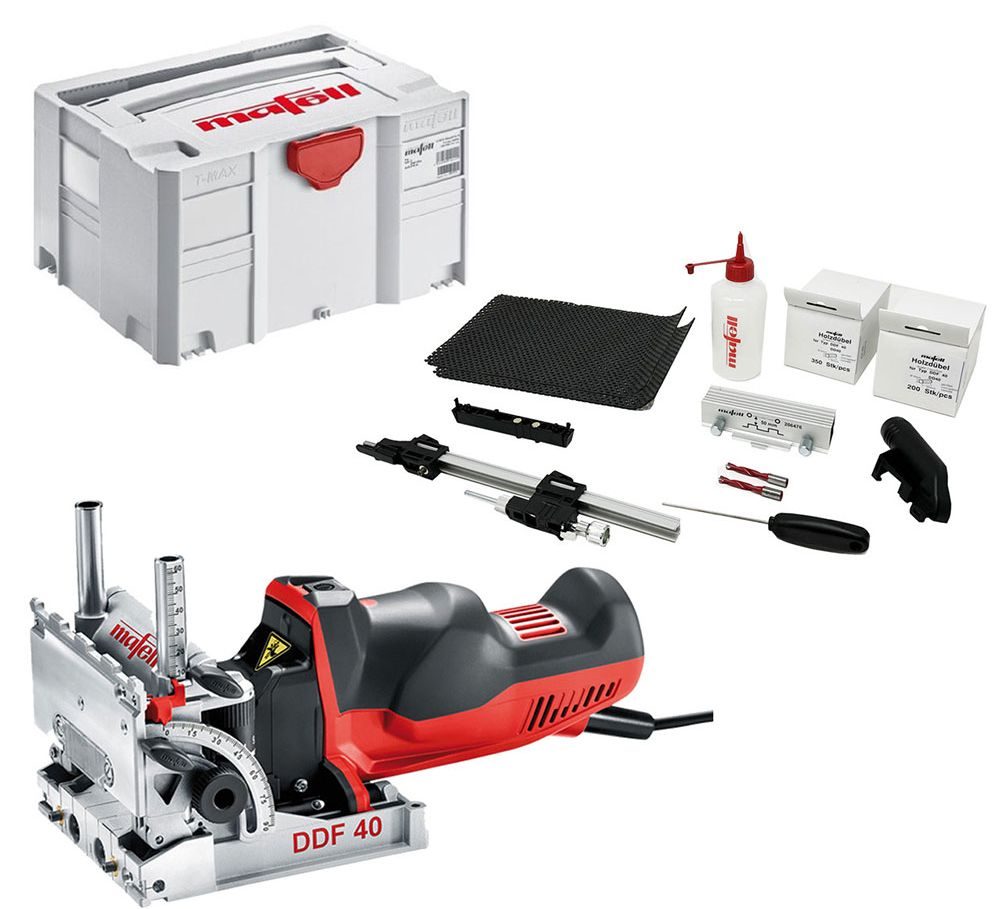
Includes: 6 mm and 8 mm carbide dowel drills (2 of each), side fence set SA 320, ancillary support ZA, batten guide fence LA, ancillary guide fence set ZAG, hose connector, anti-slip mats (2), Allen key, glue bottle, glue bottle accessories, systainer, instruction booklet.
A different kind of joinery tool
At its core, the DDF 40 is a dual-spindle dowel drilling machine designed to create perfectly aligned holes for traditional dowel joinery. Unlike a standard doweling jig or a handheld drill working one hole at a time, it drills two holes simultaneously, which guarantees consistent spacing and near-perfect alignment. In use, it feels like a bridge between handheld convenience and the accuracy you’d expect from a stationary machine.
In practical terms, the DDF 40 excels in a wide range of common woodworking tasks. It’s particularly well suited for edge-to-edge panel glue-ups, cabinet carcass construction, and face frames, where alignment and repeatability matter. It also performs exceptionally well in rail-and-stile joinery, mitered assemblies, and any situation where you need fast, repeatable hole placement. Because it uses standard wood dowels rather than proprietary tenons or connectors, you’re free to choose your own materials, which adds flexibility and keeps long-term costs down.
What stands out immediately is how strong and stable the joints feel, even before glue is applied. Paired dowels provide excellent mechanical alignment, which makes dry fitting easier and more accurate. Once glued, the joints are more than capable of handling demanding furniture and cabinet applications.
Build quality
As with most tools from Mafell, the build quality is exceptional. The machining is precise, the base registers cleanly against the workpiece, and the controls feel deliberate and well engineered. It’s the kind of tool that inspires confidence the moment you pick it up, and that confidence carries through to the finished work.
Double column guides
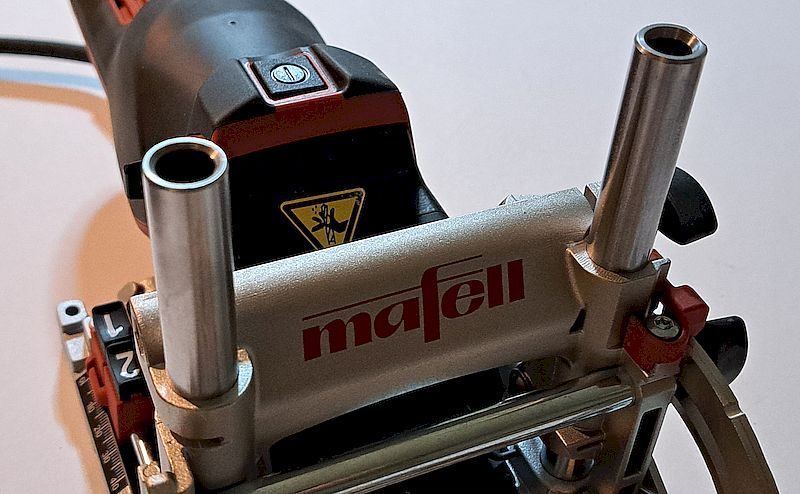
The double column guide on the DDF 40 is one of the key reasons the tool feels so precise and “locked in” compared to most dowel joiners. Instead of a single pivot or guide, the DDF 40’s tilting fence is supported on two parallel columns (guide rods) and locked with one adjustment screw. This means that the fence can’t rack or twist under pressure — it stays perfectly parallel to the cutter axis. This is a big upgrade over single-pivot designs, which can introduce slight misalignment.
Because the fence moves straight up and down your centerline stays true when adjusting height. There is no drifting as you change settings. This means your dowel holes line up perfectly across multiple parts. It also means that you get better performance on angles (miters especially). The fence tilts from 0° to 90° with preset stops. With dual columns the angle stays square and stable across the entire fence. This is why the DDF 40 excels at miter-to-miter and angled joinery.
Dual-spindle precision
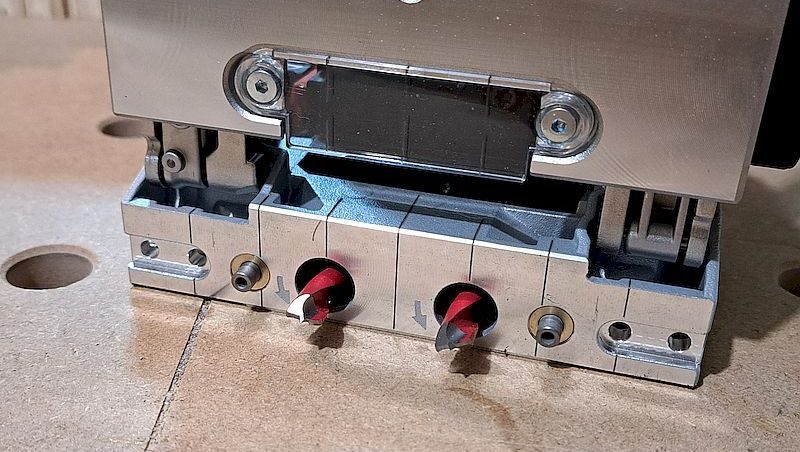
One of the defining features of the DDF 40 is its dual-spindle drilling system. By cutting two holes at once, the tool eliminates the small inconsistencies that can creep in when drilling sequentially. This not only improves accuracy, but also speeds up the workflow in a noticeable way. The adjustable fence system allows for precise control over hole spacing, depth and angle, making the tool more versatile than it might first appear.
Dowel cutter range
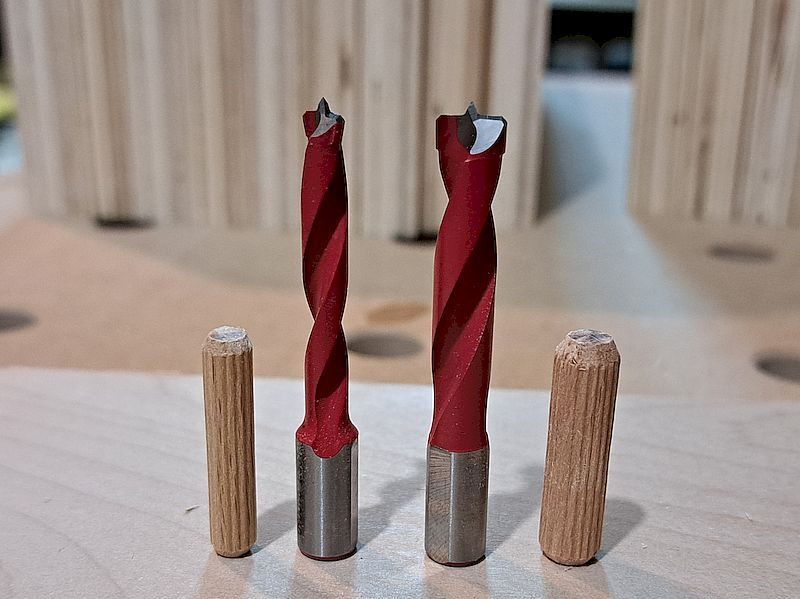
Technically, the DDF 40 can handle cutters (drill bits) from 3 mm up to 12.2 mm (about 1/8″ to 1/2″), which covers the full range of dowels I use in my shop. In practical woodworking use you’ll likely use four cutter sizes:
- 6 mm (1/4″) – very common for cabinetry and lighter work
- 8 mm (5/16″) – the most common “general purpose” size
- 10 mm (3/8″) – for heavier furniture joints
- 12 mm (1/2″) – for large, structural joinery
Drill hole depth is from 0 – 40 mm (0 – 1.57″).
The kit includes both 6 mm and 8 mm cutters along with a box of 350 6 mm x30 mm and 200 8mm x 30 mm dowels, which tells you exactly where Mafell expects most users to live.
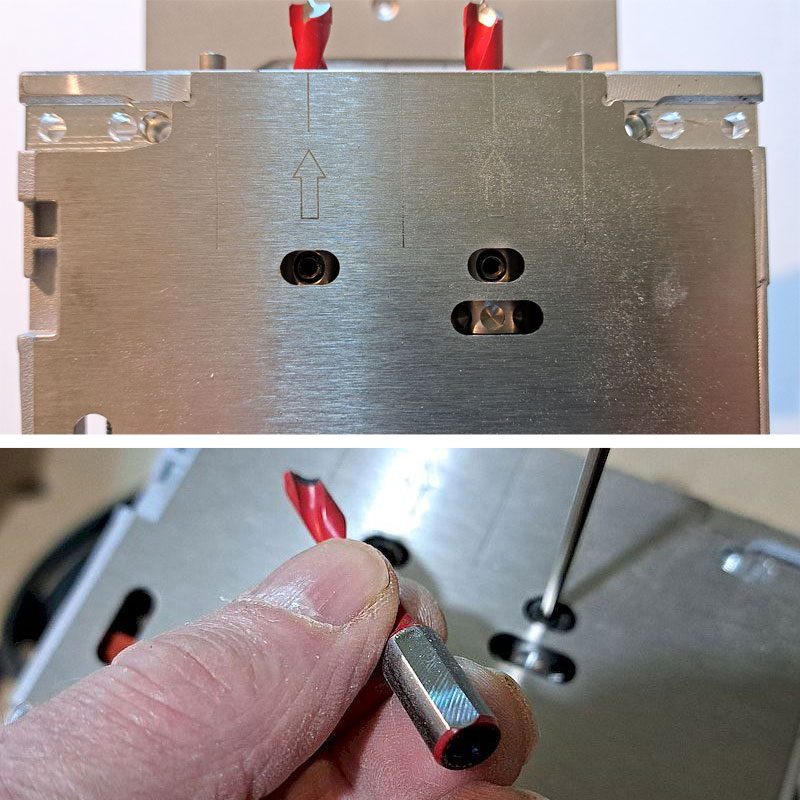
Cutter changes are quick and straightforward. Rotate the spindles until the grub screws align with the access windows in the base, then loosen the screws and remove the cutters. When installing new cutters, make sure the flats on the shanks are facing upward before tightening them securely.
Key operational features
► Height adjustment
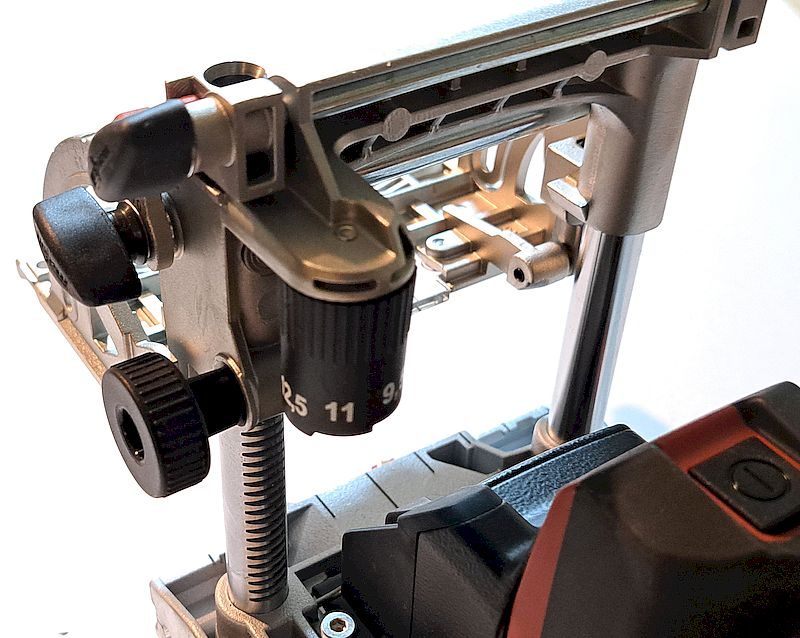 The round revolver stop makes it quick to set the fence height to one of five preset distances — 6.5 mm, 8 mm, 9.5 mm, 11 mm and 12.5 mm. You can also bypass the presets and set a custom height when needed. The preset distances are measured from the fence to the centerline of the cutters, making it easy to position dowel holes accurately from a reference face.
► Hole depth adjustment
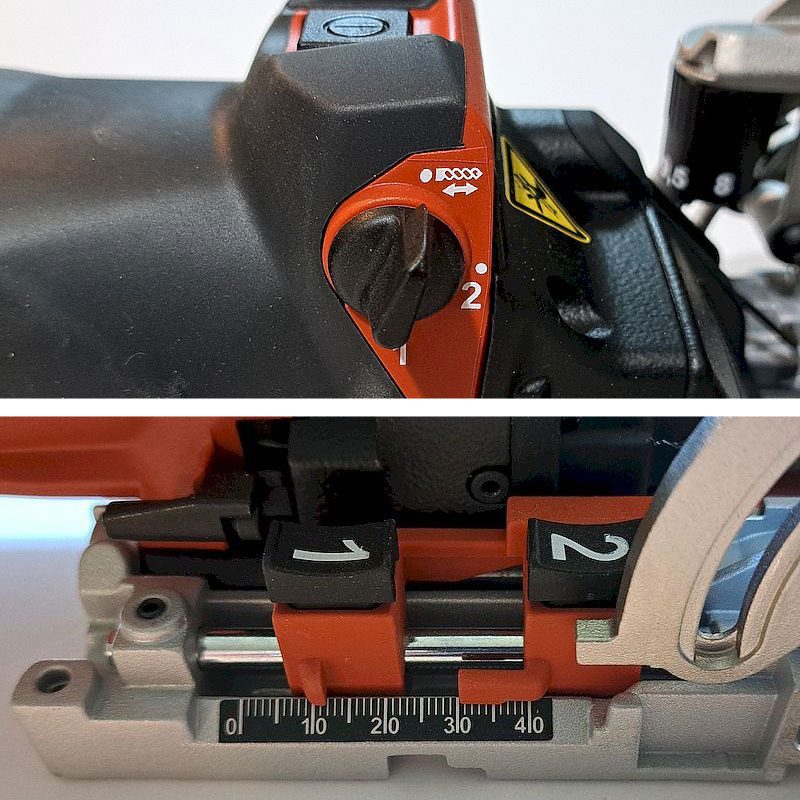
Hole depth is controlled by two adjustable depth stops that limit the plunge of the motor unit. You select the depth stop you want to use ( #1 or #2) by means of the selector knob. (The selector knob also has a tool-change position the locks the spindles so you can switch cutters).
Each stop can be set independently using the clearly marked scale (from 0 to 40 mm), allowing you to quickly switch between two preset drilling depths without resetting the machine. This is especially useful when working with different dowel lengths or when one side of a joint requires a slightly deeper hole for glue relief. Once set, the selected stop ensures consistent, repeatable hole depths across multiple workpieces.
► Angle adjustment
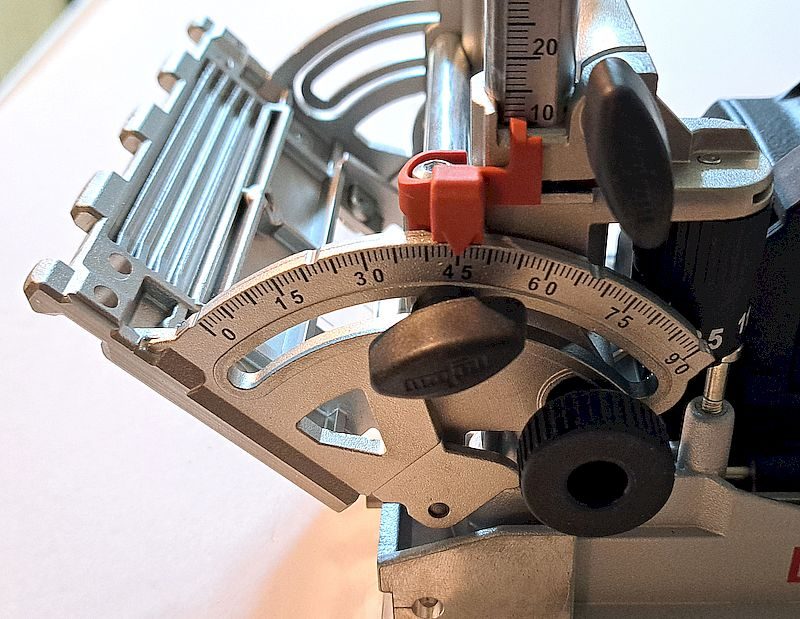 When working with bevelled stock you set the bevel angle by adjusting the swiveling guide fence — a straightforward process. The fence can be set anywhere from 0° to 90°, with detents at 0°, 22.5°, 45°, 67.5° and 90° for quick, repeatable settings.
Comparing the DDF 40 to other joinery systems
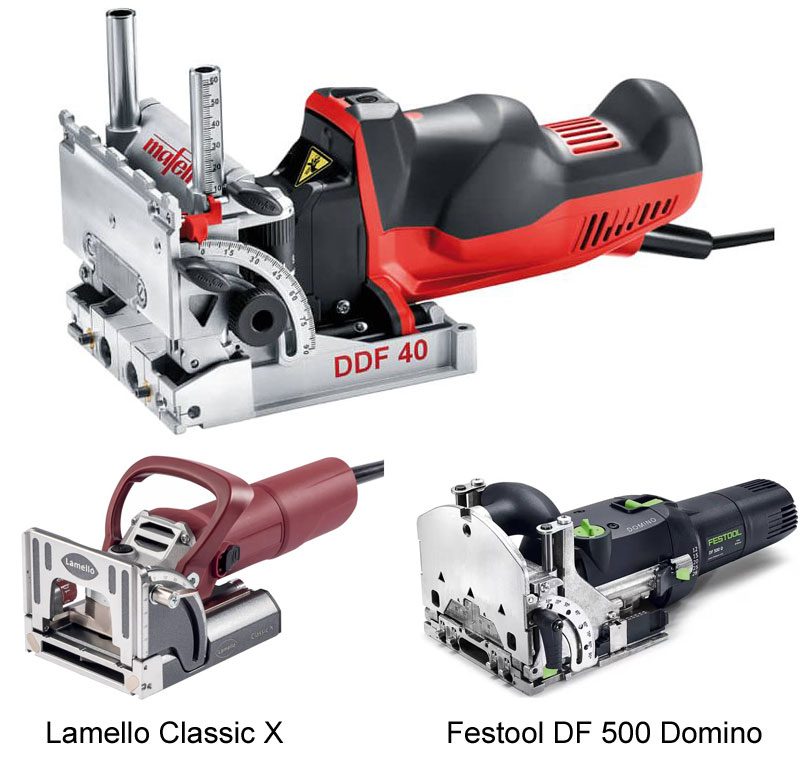 To understand where the DDF 40 fits in a modern shop, it helps to compare it to other common joinery systems. Biscuit joiners, such as the Lamello Classic X, are designed primarily for alignment rather than strength. They’re fast and affordable, and they work well for panel glue-ups, but they lack the structural integrity required for more demanding joinery. In contrast, the DDF 40 produces significantly stronger joints with far greater precision, making it a more suitable choice for cabinetry and furniture work where durability matters.
The more direct comparison is with the Festool Domino DF 500, which has become a benchmark for modern joinery. The Domino system offers impressive speed and versatility, and its loose tenon design provides excellent strength in structural applications. However, it relies on proprietary tenons, and while those are convenient, they do tie you into a specific system. The DDF 40, on the other hand, takes a more traditional approach by using dowels, while still delivering a similar level of accuracy. It may require slightly more setup in some situations, but it rewards that effort with flexibility and lower consumable costs.
There are also more traditional options, such as doweling jigs from brands like JessEm or Dowelmax, which can produce accurate results at a lower cost. However, they tend to be much slower and more dependent on careful manual setup. The DDF 40 streamlines that process considerably, making it a better fit for woodworkers who value efficiency as well as precision.
► Joinery Tool Comparison
| Attribute | Mafell DuoDoweler DDF 40 | Festool Domino DF 500 | Lamello Classic X Biscuit Joiner |
| Joinery type | Dowels (dual holes) | Loose tenons | Biscuits |
| Accuracy | Exceptional | Exceptional | Good |
| Speed | Fast | Very fast | Very fast |
| Setup complexity | Moderate | Low | Low |
| Consumables | Standard dowels | Proprietary tenons | Biscuits |
| Joint strength | Very high | Very high | Moderate |
| Repeatability | Excellent | Excellent | Good |
| Versatility | Moderate | High | Moderate |
| Best use | Cabinets, panels, precision joinery | Furniture, structural joinery | Panel alignment, light joinery |
| Unique advantage | Dual-spindle precision drilling | Fast, flexible mortise system | Quick, simple alignment |
In practical terms, the Mafell DuoDoweler DDF 40 stands out for its accuracy and repeatability, the Festool Domino DF 500 dominates in versatility and speed, and the Lamello Classic X Biscuit Joiner remains a simple, efficient solution for lighter-duty work.
Joints the DDF 40 excels at
This is where the DDF 40 starts to shine. I’ve listed below five of the more common joints that you can make the tool. In general you’ll want to use 6 mm dowels for 1/2″ stock, 8 mm dowels for 3/4″ stock (which is ideal), and 8 mm for 1″ stock with 10 mm as an optional but rarely necessary upgrade. Drill each dowel to a depth of 10–15 mm per side.
► Edge-to-edge panel glue-ups
For edge‑to‑edge panel glue‑ups, the goal is alignment rather than strength. Space dowels every 150–250 mm (6–10″). In this application, dowels function primarily as alignment pins, so avoid oversizing them.
► Cabinet carcasses (boxes and casework)
For cabinet carcasses, the goal is strength combined with repeatable accuracy. For material thicker than 1″ you might want to move up to 10 mm holes, drilled to 15–20 mm per side.
► Face frames
For face frames, the goal is clean, fast joinery in narrow stock. In typical 3/4″ × 1‑1/2″ material, either 6 mm or 8 mm dowels work well. When parts are narrower than about 40 mm (1‑1/2″), lean toward 6 mm to reduce the risk of splitting.
► Furniture joinery (aprons, rails, frames)
For furniture joinery, the goal is structural strength. For light‑duty joints in 3/4″ stock stay with 8 mm dowels, while for 7/8″ – 1″ material move to 10 mm dowels and 10 – 12 mm dowels for stock 1‑1/4″ and thicker. Drill 10 mm dowels to 18 – 22 mm and 12 mm dowels to 20 – 25 mm per side. For table bases and chairs, 10 mm dowels are the most reliable choice.
► Small boxes & light joinery
For small boxes and other light joinery, the goal is precision without weakening the parts. You’ll almost exclusively use 6 mm dowels, though for stock thinner than 1/2″ consider 4 – 5 mm dowels. Drill to a depth of 8 – 10 mm per side. In small‑scale work, smaller dowels are often stronger because they preserve more surrounding material.
For most of what I do in my shop, cabinetry and furniture, the typical set-up I use is:
- 8 mm cutter installed by default
- Fence dialed for 3/4″ stock
- Depth preset around 13–15 mm
Plywood vs. solid wood (important differences)
► Plywood
With plywood, the main differences are that edge‑holding strength is weaker than in solid wood, and voids — especially in lower‑grade panels — can reduce dowel grip. The best practice is to stick with 8 mm dowels in 3/4″ plywood and avoid oversizing, since 10 mm dowels can remove too much surrounding material. Keep dowels well‑centered within the ply layers, and use a greater number of dowels rather than larger ones. In plywood, think in terms of quantity rather than size.
► Solid wood
With solid wood, the key differences are stronger long‑grain holding strength and a higher risk of splitting when joints are placed too close to edges. You can safely step up in dowel size — for example, using 10 mm dowels in 1″ stock — but you must pay attention to grain direction and avoid drilling too close to end‑grain edges. Always leave at least 2 – 3 mm of wall thickness around the holes. In solid wood, strength is higher overall, but the risk of splitting increases accordingly.
DDF 40 accessories
► SA 320 side fence
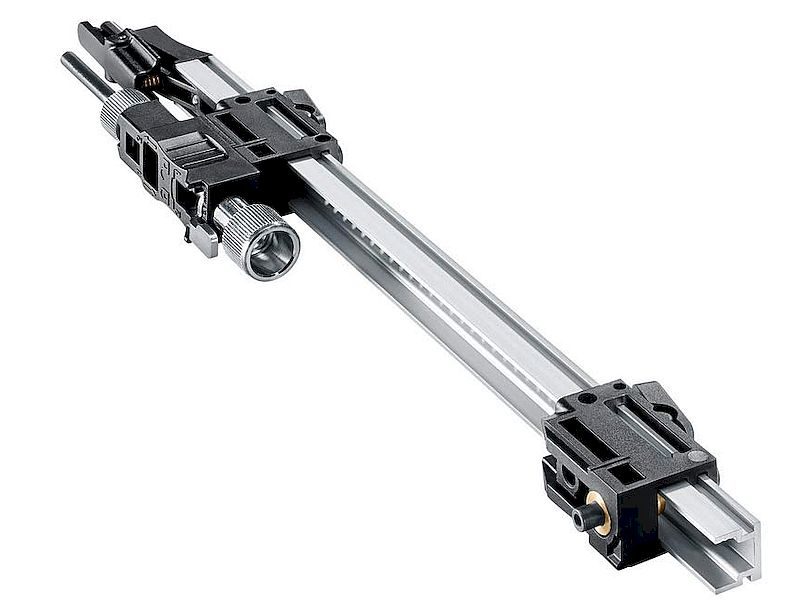
The SA 320 side fence (aka lateral stop) is a side‑mounted fully adjustable referencing accessory designed to give you a stable, repeatable lateral registration surface when drilling dowel holes. It attaches to the machine’s base plate and extends outward to create a broad, square reference face that provides large, variable offsets ranging from roughly 105 mm to 320 mm.
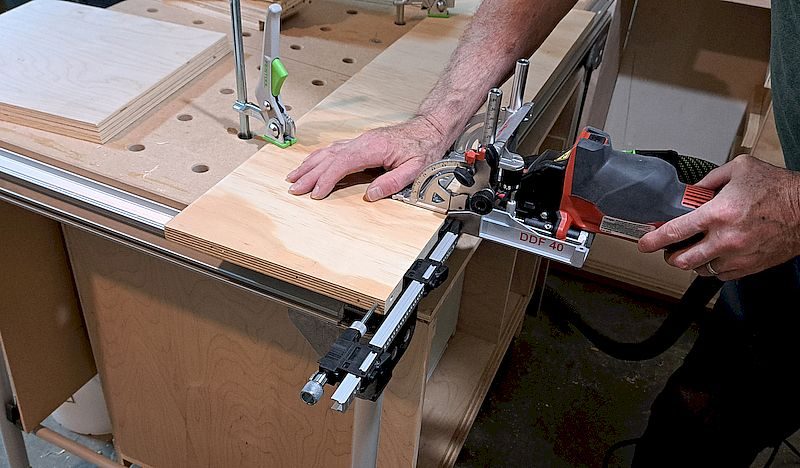
Unlike ZAG stops (see below), it doesn’t rely on direct edge contact; instead, it acts like a sliding fence that keeps the machine parallel to the workpiece edge while maintaining a consistent distance. This makes it ideal for panel work, shelf‑pin rows, hardware drilling, and wide setbacks where the ZAG stops can’t reach. The SA 320 is slower to set up than the ZAG system but offers far more range and precision for large offsets.
► PAZ position indicator
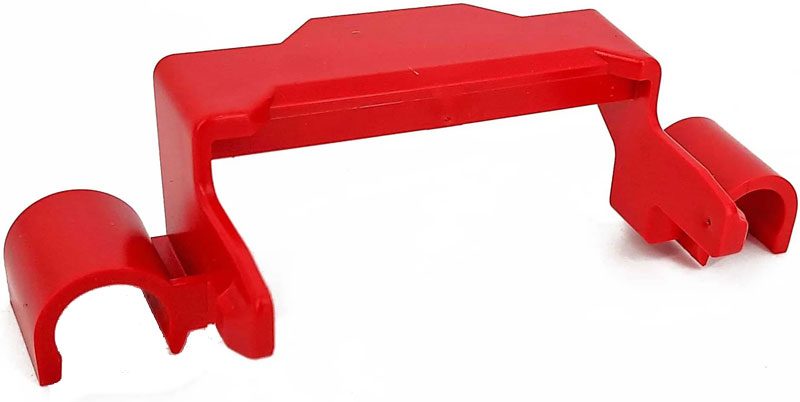
The PAZ position indicator is a small accessory that becomes surprisingly valuable once you understand how it is intended to be used. It attaches to the front of the DDF 40 and provides a sight window that aligns with your pencil line, allowing you to position the machine precisely over a marked location. The PAZ is most useful in custom layouts, furniture work, long rails, frames, and non‑standard spacing, where the drilling position must match a mark rather than a mechanical stop. It is essentially the opposite of the ZAG system: instead of speed through presets, it gives you accuracy through visual targeting.
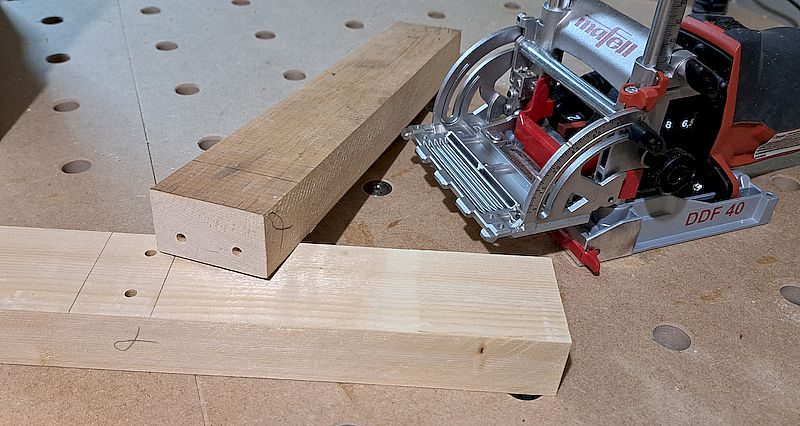
You generally won’t need the PAZ when you are using the built‑in 32 mm system spacing, working off fences, stops, or pins, or doing repeat cabinet work with fixed setups, because in those cases the machine’s mechanical referencing is faster and more efficient.
A simple way to think about it is that ZAG stops and the SA 320 fence give you speed and repeatability, while the PAZ gives you flexibility and layout‑based accuracy. I find the PAZ most useful when doing custom layouts, when parts are not identical, or when I need to hit exact marked positions.
► ZAG auxiliary stop system
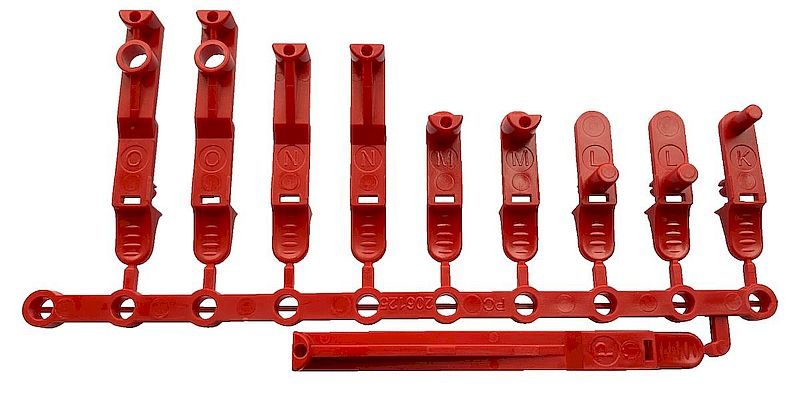
The ZAG system is a set of plastic clip‑on preset stops — K, L, M, N, O and P — that give you instant, repeatable edge offsets without measuring or marking. Each stop provides a fixed, known distance from the workpiece edge, so you simply clip on the stop that matches your desired setback and drill. This makes the ZAG system ideal for fast, repetitive cabinet joinery, where the same offset is used across many parts. You’ll find them useful for edge joinery, rows of holes, narrow workpieces and miter joints.
The ‘N’ stop sits roughly in the middle of that range and is commonly used for standard cabinet offsets, general‑purpose positioning, and situations where the built‑in pins don’t match your layout. In other words, it’s one of the everyday stops rather than a specialty one.
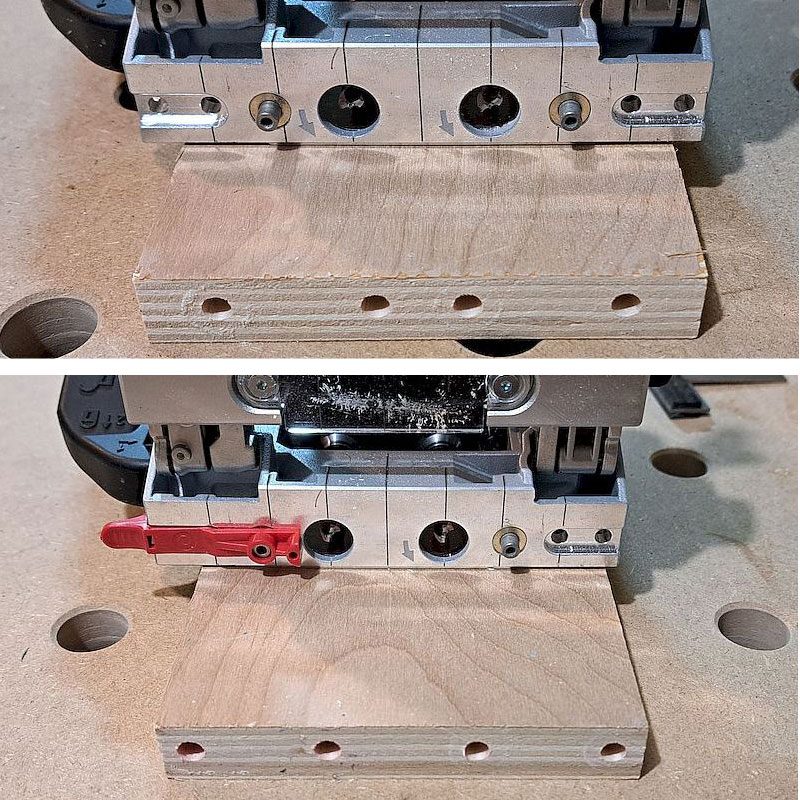
These are the center‑of‑bit offsets each stop produces when clipped onto the baseplate:
| Stop | Offset | Usage |
| K | 10 mm | Very close to the edge; used for narrow stock and tight joinery. |
| L | 12 mm | Slightly larger offset; common for small frames and rails. |
| M | 15 mm | Mid‑range offset; useful for general joinery. |
| N | 20 mm | The “everyday” stop; ideal for standard cabinet offsets. |
| O | 25 mm | Wider offset for thicker stock or inset joinery. |
| P | 30 mm | Largest preset offset; used for wide panels or deep setbacks. |
► ZA 22 support bracket
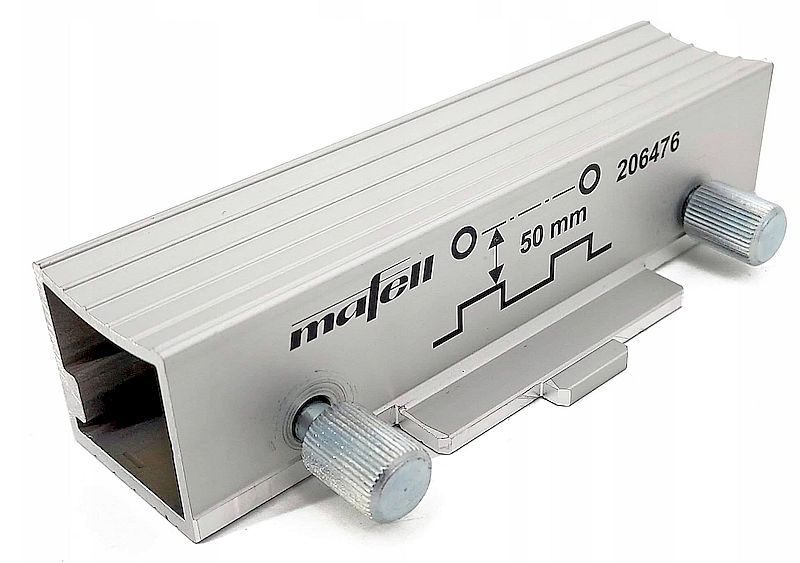
The ZA 22 support bracket serves two primary functions. On its own, it provides additional support and stability when drilling vertically, helping to keep the machine square to the workpiece.
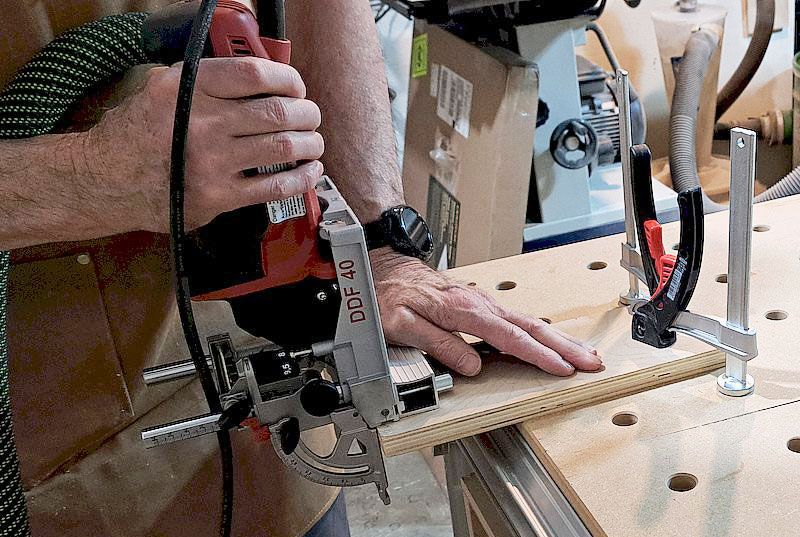
It can also be used in conjunction with the drilling template (part #203980) to guide the machine when drilling a series of evenly spaced holes, such as for shelf pins or systemized cabinetry. The template itself follows the 32 mm system, with indexing at 32 mm intervals to ensure consistent spacing. The reference to 50 mm relates to the machine’s fixed spindle spacing — not the hole pattern created by the template.
► Stop pin insert for battens LA
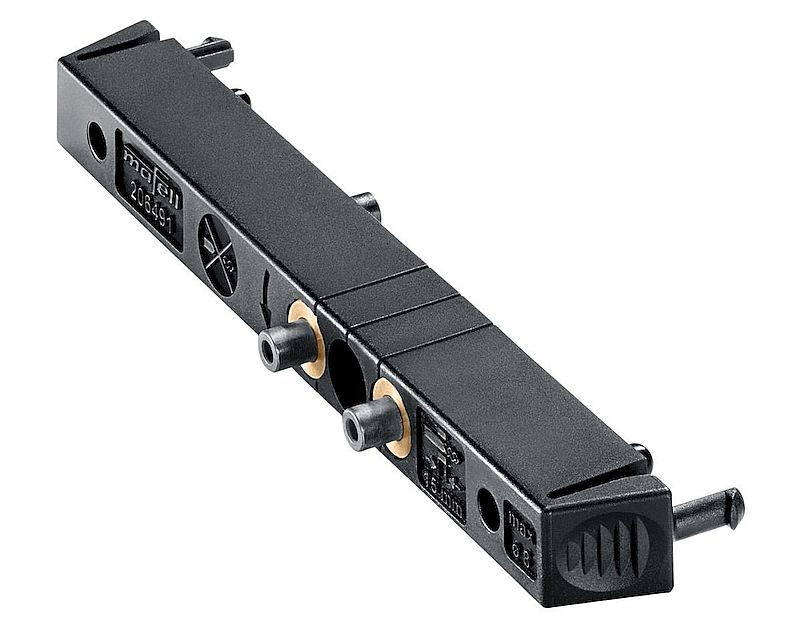
The stop pin insert for battens LA is a specialized accessory that adapts the tool’s indexing system for use on narrow stock. It allows the machine to register accurately on stock that is between about 14 mm and 48 mm wide — where the standard base and stop pins would otherwise have limited contact and stability. By providing a more reliable reference point, the insert helps maintain consistent edge distances and repeatable hole spacing, making it possible to drill precise dowel holes in narrow parts such as rails, face-frame components, and trim pieces with the same confidence as on wider panels.
► Simple memory trick
Confused about which of the five DDF 40 accessories to use? Here is a quick way to remember which accessory you need to reach for:
- PAZ — Precision from pencil lines
- N Stop — Near edge, no measure joinery
- SA 320 — Side fence for wide offsets
- ZA 22 — Vertical support and stability
- LA Insert — Batten alignment and repeat spacing
Tips and techniques for best results
These are the foundations of accuracy — small adjustments make big differences.
► Alignment & setup: To get the most accurate results from the DDF 40, rely on the PAZ position indicator to set precise distances from approximately 19–60 mm, use the SA 320 lateral stop for larger edge offsets (up to around 320 mm), and always zero and lock the tilting fence before making adjustments so your angle settings remain consistent.
► Precision drilling: You’ll get the best repeatability from the DDF 40 when you stop thinking in terms of measuring and start thinking in terms of referencing. Use the stops — especially the “N” stop — to register from a consistent edge, work from layout lines instead of hole centers, and let the machine’s alignment system do the heavy lifting. Clamp when you can, and the results become almost foolproof.
► Joinery workflows: The DDF 40 excels at cabinet carcasses when both mating parts reference the same face, at face frames where the PAZ and “N” stop help maintain consistent offsets, at panel glue-ups where shallow depth settings prevent breakthrough, and at shelving systems where a lateral stop (such as the SA 320) helps maintain consistent row spacing.
► Machine handling: You’ll get the cleanest results by letting the carbide bits cut at their own pace, setting the correct drilling depth for each dowel size and material thickness, and keeping the guide columns clean so the plunge action stays smooth and controlled.
► Consistent maintenance: Regularly cleaning the base plate, ensuring the tilting fence and PAZ mechanism engage positively, monitoring bit sharpness, and following the manufacturer’s setup guidelines will keep the machine performing at its best.
► Pro tips: You can speed up repeat setups by using reference blocks at common offsets, batching left-hand and right-hand parts separately to avoid mirrored errors, using a dust extractor with strong suction to keep holes clean, and applying glue directly into the holes before inserting dowels with a slight twisting motion for even distribution.
► Common mistakes to avoid: Avoid referencing different faces on mating parts, forgetting to lock the tilting fence, using an incorrect stop or offset setting, skipping test holes after changing setups, or letting dust build up on the base plate or guide columns.
Mafell‑ish
As with many high-end power tools made in Germany, some of the terminology used to describe parts and functions can feel a bit unfamiliar at first. I did a bit of digging to better understand a few of the terms Mafell uses.
► PAZ is almost certainly an abbreviation of the German “Positions-Anzeige,” which translates roughly to “position indicator.”
► ZAG, the category label for the family of clip-on stops (K through P), is likely shorthand for “Zubehör-Anschlag-Gruppe,” meaning “accessory stop group.” In practical terms, it helps to think of PAZ as a single accessory with a specific function, while ZAG refers to a broader system or group of related accessories.
► SA 320 likely stands for “Seitenanschlag,” or “side fence.” 320 refers to the maximum offset range you can achieve with this accessory.
► LA Insert most likely refers to the German word “Leiste”, which translates to “batten,” or “narrow stock.”
My experience with the DDF 40
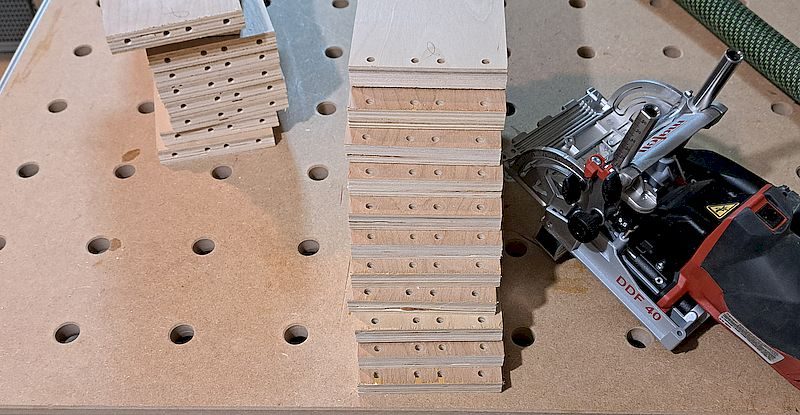
I recently put the DDF 40 to work building a set of five plywood drawers for my workshop, pairing it with the ZA support bracket. The whole process felt almost unfairly smooth. Drilling the 40 sets of dowel holes took about 20 minutes, and gluing and clamping the boxes took roughly the same. What really impressed me was the accuracy: once the dowels were tapped home, every single hole lined up perfectly, and the drawer sides sat dead‑square to the fronts and backs without any coaxing.
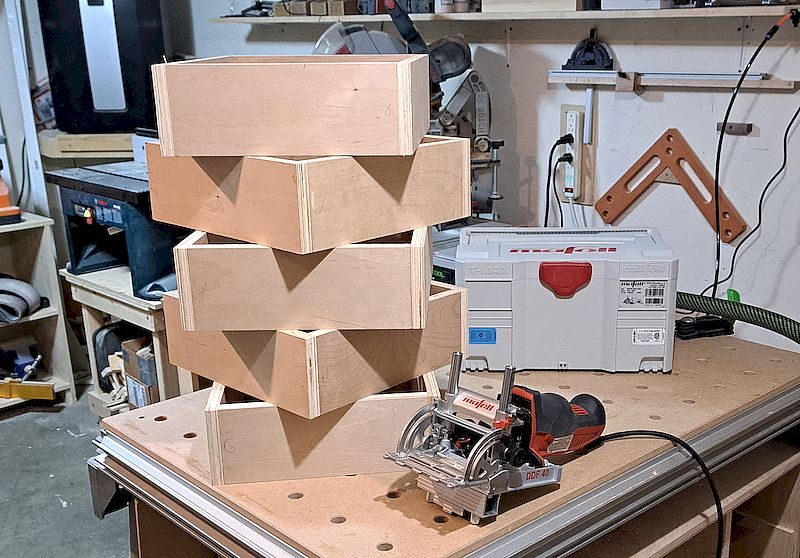
I also brought the SA 320 side fence, the PAZ position indicator, and the ZAG stops into the mix. All of them were quick to install, intuitive to adjust, and made the workflow feel more like a guided system than a collection of accessories. By the end, I was reminded why I enjoy using the DDF 40 so much — it turns what could be fussy joinery into a clean, predictable, almost meditative process.
Is the DDF 40 worth it?
For studio furniture makers, small cabinet shops, and serious hobbyist woodworkers, the question of value ultimately comes down to how often you’ll use it—and how much precision matters in your work. The DDF 40 is undeniably a premium tool, but for those building furniture or cabinetry on a regular basis, it can significantly improve both workflow and results. It’s not a casual purchase, but it’s one that pays off in accuracy, efficiency, and overall satisfaction at the bench.
While the DDF 40 is relatively easy to use straight out of the box, getting the most out of it requires a committed investment in practice and testing. Like many Mafell tools, its real advantage shows up once it becomes integrated into your process. There are a series of 10 videos on the Mafell YouTube channel to help you get started with the DDF 40.
Consumables are another important consideration. One of the advantages of the DDF 40 is its use of relatively inexpensive, widely available dowels. For example, a 10,000-piece box of 5/16″ × 1-1/2″ dowels can be purchased for roughly $400. By comparison, an equivalent quantity of #10 biscuits can cost around $600–$700, while the same number of Festool Domino tenons can approach $3,000.
Who Should Buy It — and Who Shouldn’t
If you’re building furniture or cabinetry regularly and value repeatable accuracy, the DDF 40 makes a compelling case for itself. It’s especially well suited to small shops and serious hobbyists who want the strength and precision of dowel joinery without the setup time of traditional methods. In that context, it’s not just a convenience — it’s a meaningful upgrade to how you work.
On the other hand, if your projects are occasional, your joinery needs are simple, or you’re already well served by biscuits, pocket holes, or even a Festool Domino DF 500, the DDF 40 is harder to justify. It doesn’t replace every joinery method, and if it’s only coming out a few times a year, its cost — and capability — will likely be underutilized.
In short, the DDF 40 is a tool for woodworkers who prioritize precision and efficiency in equal measure. If that’s central to how you work, it’s worth it. If not, it’s probably more tool than you need.