
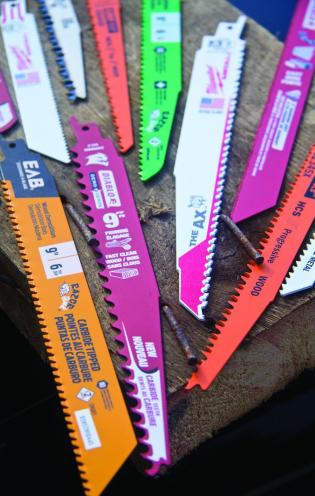
A reciprocating saw is one of the most useful power tools you’ll ever own for construction, renovation and demolition work. To get the most out of your saw, you need to use the right blade for the material and situation you’re dealing with.
Photos by Rob Brown
You’ll find job-specific reciprocating (recip) saw blades for just about everything – cutting nail-free wood, nail-embedded wood, non-ferrous and ferrous metal, masonry, plaster and drywall, fibre cement, rigid foam, and fibreglass. There are also specialty blades for making flush cuts, removing grout, scraping, sanding, pruning trees and shrubs, and removing paint and rust.
This article looks at some of the key features you need to know about when selecting recip blades for nail-free wood, nail-embedded wood and metal, the three materials you’re most likely to encounter.
These are the least expensive blades you can buy; both blade and teeth are made of HCS. Because the blades are fairly flexible, they’re not overly prone to breaking, though the teeth deteriorate quickly. These blades are best used for cutting clean softwood, hardboard and plastics, and not recommended for demolition work or cutting metal. The blades can have variable-sized teeth and gullets for faster chip removal.
HSS is much more durable and heat-resistant than HCS so these blades will last appreciably longer. However, they aren’t as flexible as HCS blades making them somewhat more prone to breaking. They’re a better choice when cutting both non-ferrous (aluminum, copper, lead, zinc and tin) and ferrous (mild steel, carbon steel, cast iron and wrought iron) metal.
Blades that combine a HCS body and HSS teeth are known as bi-metal blades. The blade is both flexible and break-resistant while the teeth have enough hardness and durability for general duty work, which makes them the most popular recip blades. Some manufacturers coat either the whole blade or blade teeth with titanium or cobalt-steel alloy to provide better heat- and wear-resistance and extend blade life.
Blades marketed as “general purpose” or “demolition” tend to have thicker profiles and hardened teeth. Some have variable teeth spacing. These blades are best suited for more extended use in nail-embedded wood and both non-ferrous and ferrous metal. There are also Fire & Rescue blades, which also have thicker blades and often a curved blade design for faster cutting.
These are the toughest, longest-lasting blades you can get. The blade is typically bi-metal, with heat-resistant and impact-resistant tungsten carbide or titanium carbide teeth. They’re a better choice when you have a lot of nail-embedded wood or metal to cut (including stainless steel and high strength alloys). They cost more than standard bi-metal blades but last considerably longer, giving you a much better return on investment.
Use these blades for masonry, ceramic tile, fibre cement, cast iron and the like. Just remember: they don’t cut, they grind. Wear a respirator to avoid breathing in the fine particulate material. Diamond blades cut faster and last longer than carbide blades, but cost more.
While you may be more familiar with CMT as a maker of premium quality table saw blades and router bits, they also manufacture a line of HCS blades for wood (3, 5, 6 and 6/10 TPI), and BIM blades for wood and metal (6, 10, 8/12 and 10/4 TPI). There is also a BIM rescue/demolition blade (5/8 TPI) and a 6 TPI carbide blade. Blade lengths include the standard 6″, 9″ and 12″ plus some 8″. CMT blades features a non-stick Orange Shield coating that helps to keep the blade running cool and reduces pitch build-up and corrosion.
This Canadian company has an extensive range of blades. Blades come in Industrial (premium) and Professional (contractor) grades. The EAB blades are the company’s flagship line of exchangeable blades for wood (HCS in 3 TPI and BIM in 3 and 6 TPI), wood and metal (BIM in 10/14 TPI), and metal (BIM in 10, 14, 18 and 24 TPI). There are also blades for pruning (9″ BIM in 5 TPI), plaster (6″ BIM in 6 TPI) and fire/rescue (9″ BIM in 10/14 TPI). There is also a Stay Sharp line consisting of HCS (3 and 5 TPI), BIM for wood (6 TPI), BIM for wood and metal (10/14 TPI), BIM for metal (10, 14, 18, and 24 TPI), and carbide grit edge blades. In the Razor Back demolition line are both exchangeable and recyclable BIM blades (6 and 8/10 TPI) and exchangeable carbide blades (6 TPI).
With woodworkers and DIYers getting more environmentally conscious every day, it’s nice to see some companies catering to the current approach of ensuring a sustainable future. EAB, with their Exchange-A-Blade program, provides customers with savings once they return the used product. Norske, and their Trade-A-Blade system, provide credits towards future purchases for returning their products after use. These companies carry not only a wide range of reciprocating saw blades, but also an extensive selection of blades, bits, abrasives and much more. These services are convenient for customers while reducing waste and making better use of natural resources. Once these products are used and returned they’re either re-sharpened, if possible, or properly recycled. Visit ExchangeABlade.com and NorskeTools.com for more information on their systems.
Diablo has one of the largest selections of carbide blades. They manufacture their own high-density carbide from 5-micron carbide grain rather than the more typical 1-micron grain. For clean wood they have HCS (5 TPI) and carbide (3 TPI) blades, while for nail-embedded wood there are BIM (4/6 TPI) and carbide (5/7 TPI) blades. For general purpose (wood and metal) cutting there are BIM (10/14 TPI) and carbide (6/9 TPI) blades. When it comes to cutting metal, Diablo has BIM and carbide blades for thin (under 3/16″), medium (under 5/16″) and thick (under 1/2″) stock. You’ll also find a diamond grit blade for cast iron, fibre cement, masonry, and fibreglass, a carbide (32 TPI) blade for HVAC and ductwork, and a carbide (5 TPI) blade for scrolling and radius cutting. All Diablo blades have a Perma-SHIELD Non-Stick Coating.
The Milwaukee AX blades are for wood cutting – they come in BIM (5 TPI with a fang tip for plunge cutting), and carbide (3 TPI and 5 TPI) for either wood or nail-embedded wood. Most of these blades are available singly or in packs of 5, 10, 25 or 100 blades. Wrecker multi-material blades are for cutting nail-embedded wood, PVC / plastic and thick metal. They come in either BIM (with 7/11 TPI) or carbide (6 TPI with a fang tip). For cutting metal there are TORCH blades in BIM (10 to 24 TPI) and carbide (7 TPI) for both thick metal and cast iron. All Milwaukee blades are made in the U.S.
These German-made blades come in 7 BIM blade styles along with a tungsten carbide grit blade for cast iron and masonry and carbide (6 TPI) for hardy plank, pressure treated lumber, cement board and fibreglass. The BIM blades include a curved blade with wavy teeth set (18 TPI) for cutting metal, a demolition blade for wood (6 TPI) and a separate demolition blade for metal (10 TPI). Their blade for nail-embedded wood features a patented “M-Tooth” design that cuts on both the forward and backward stroke to deliver super quick cuts. They also offer a fire/rescue blade (6 TPI) and a pruning blade (3 TPI).
Metabo carries 5 and 6 TPI HCS blades for wood; 6 TPI BIM blades for nail-embedded wood; 10/14 TPI general purpose (wood and metal) BIM blades; 6 and 8/10 BIM demolition blades; and 10, 14, 18 and 24 TPI BIM blades for metal. They also have specialty carbide grit blades and carbide blades (2, 3, 6 and 18 TPI) for fibre cement and tile, along with a carbide blade (2 TPI) for brick.
Along with the six brands we’ve listed above, you’ll also find recip blades from a range of other companies, including Bosch, DeWALT, Imperial Blades, Irwin, Spyder, Lenox, Makita, MK Morse and Starrett.



Hey, my name is Fred and I am looking for a 4 foot reciprocating saw to cut insulation in between studs in my shop. Don’t know where to start looking. Maybe you could help me out. I’d appreciate anything at all. My number is (910)366-3652
I’ve not see any recip saws with 4-foot blades Fred. However there are specialized insulation hand saws – a search of the internet will turn up some.