
Unlike handheld sanders, which rely on the user’s steadiness and technique, a stationary edge sander provides a long, flat platen and a continuously running sanding belt that allow you to produce crisp, accurate edges with remarkable consistency. Woodworkers use edge sanders for tasks such as flushing solid wood edging to plywood, smoothing sawn edges, fine-tuning joinery components, and shaping and smoothing curves.
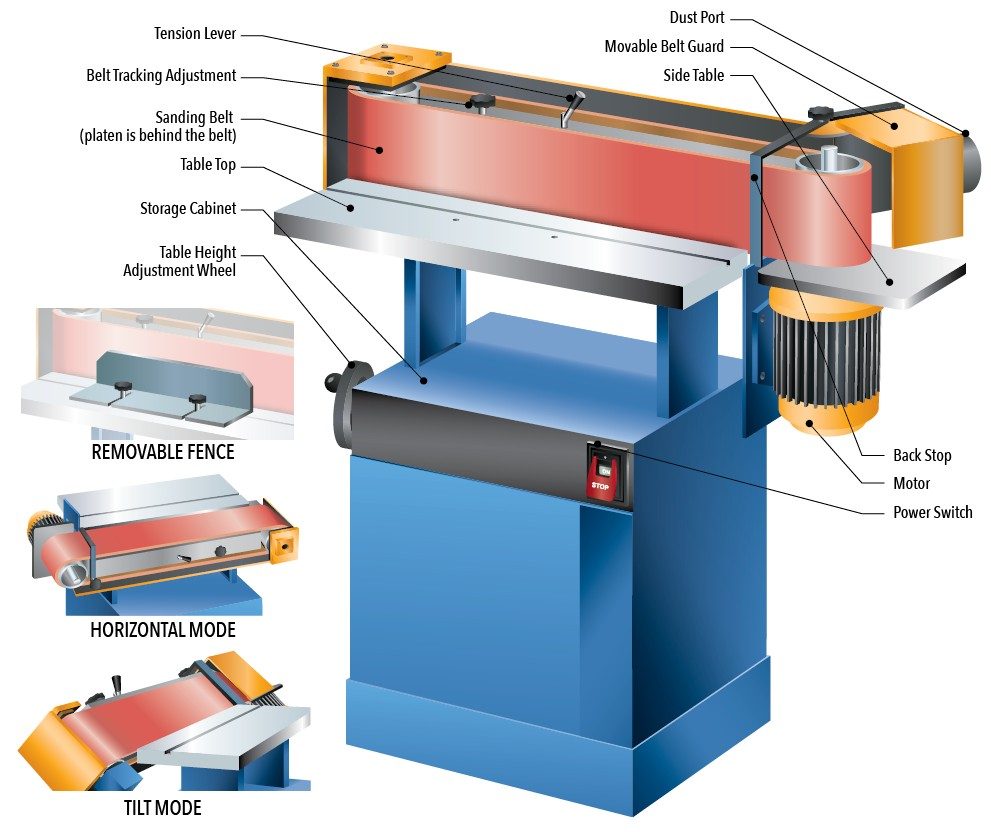
Most edge sanders feature a long horizontal belt — often about 6″ wide and 80″ to 108″ long — that travels over a rigid platen to ensure flat, uniform sanding. The belt runs at high speed, enabling you to remove material quickly while still maintaining excellent control. A robust, adjustable table sits in front of the belt and provides solid support for the workpiece. The table typically tilts up or down to allow for sanding bevels or cleaning up angled joinery. Oscillating models move the belt up and down slightly as it runs, which helps distribute wear over a larger section of the abrasive, produces a smoother, more uniform surface, and extends belt life.
One of the defining advantages of an edge sander is its ability to sand both straight and curved edges. The exposed end of the belt, supported by the sanding drum, allows you to shape inside curves, refine rounded profiles and clean up template-routed parts. Many models include a belt-tracking adjustment to keep the belt running true, along with quick-release mechanisms that make belt changes fast and tool-free. A reliable dust collection port is standard, helping to keep the work area clean and the abrasive belt running efficiently.
Because edge sanders remove material rapidly, they’re especially helpful when preparing parts for joinery, fitting doors and drawers, and smoothing edges before finishing. For anyone looking to improve the accuracy, speed and quality of edge work, a stationary edge sander is an invaluable addition to the workshop.
Motor power: 3/8 HP to 4 HP
Belt speed: 2,000 to 4,000 ft/min
Oscillation stroke: 1/4″ to 3/4″
Table width: 8″ to 12″
Get the most out of your stationary belt sander
Use the full length
Avoid sanding exclusively in one spot on the sanding belt. Move the workpiece along the length of the belt so the wear is even.
Keep it flat
Maintain firm contact between the workpiece and the table and avoid lifting the trailing end as you exit the belt.
Use light pressure
Let the machine do the work. Moderate, even pressure gives you a smoother finish and keeps the belt from overheating.
Switch grits
After rough shaping at 80–100 grit, move to 120–150 grit to refine the edge, tune the fit of doors or drawers, or clean up joinery.
Use the drum end
The exposed end of the belt is ideal for smoothing inside curves, refining template-routed parts and shaping radiused corners.