
TIPS & HOW TO
Planning and making gingerbread trim

Carl Duguay
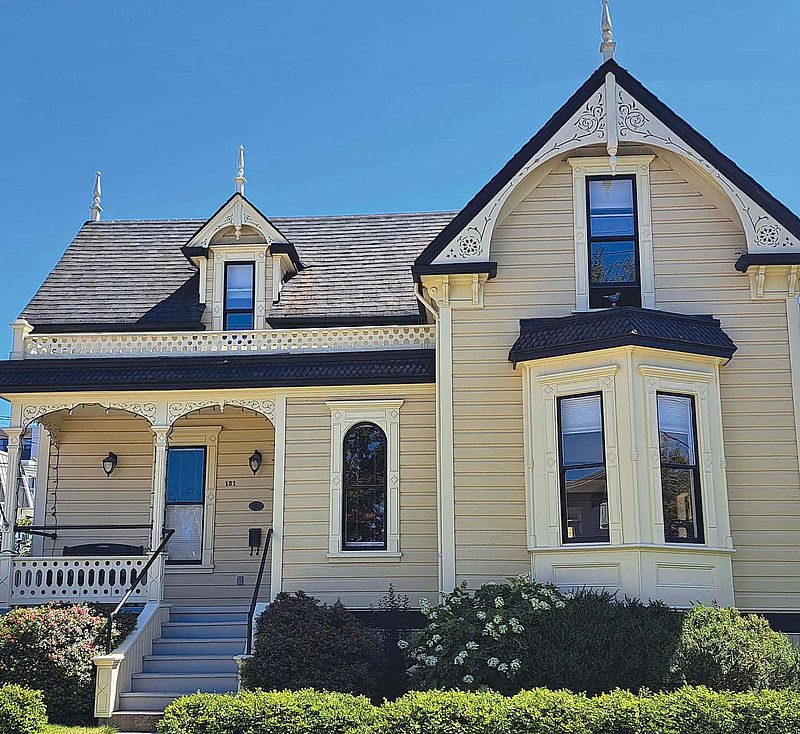
Elevate the look of your home with gingerbread trim.
Apart from being a tasty treat, gingerbread can also refer to the decorative architectural accoutrements – ornate or simple – that graced Carpenter Gothic-style houses built in the 19th century across much of the U.S. and parts of Canada, notably Ontario, Quebec and British Columbia. Thousands of these houses grace the small towns of Ontario with their own unique style called “Ontario Cottage”.
These houses are generally small one- or two-storey structures with steeply pitched gable roofs, often centred above the entrance door of the house, along with gable ends typically decorated with rake boards (a.k.a. bargeboards). Pointed-arched windows, elaborate door and window trim, and wood siding (usually vertical board and batten, horizontal clapboard, or cedar shingles or shakes) are also common features. Shingle siding is often enhanced with geometric edges such as scallops, octagons and half-coves.
Houses best suited for gingerbread are those with gable roofs and open porches or verandas.
Basic components
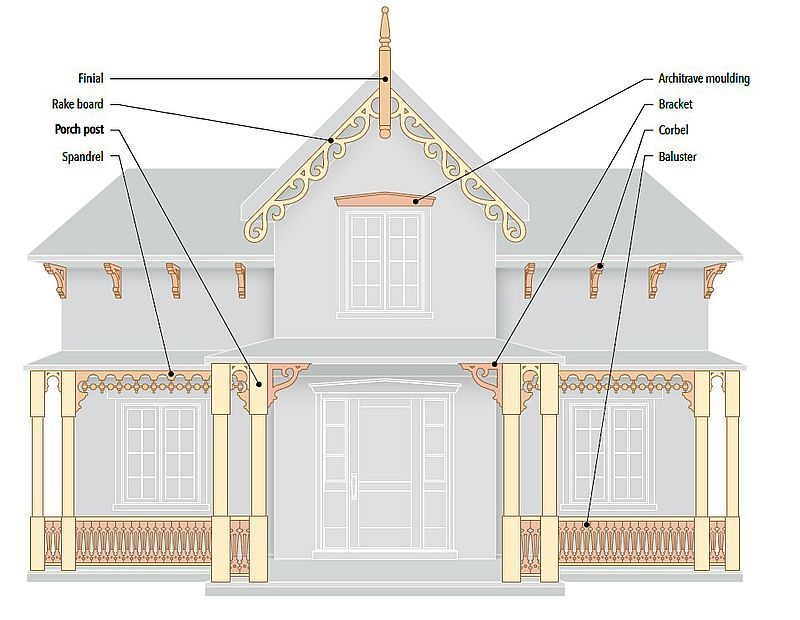
There is a considerable amount of variation in the architectural components on gingerbread houses. Here are seven of the most commonly found decorative elements.
Finial: A finial (a.k.a. roof spire) puts the finishing touch on top of a house. Some gingerbread houses have an upside-down finial (called a gable drop) at the centre point of a gable roof. You’ll also find finials atop stair and deck posts.
Rake board: These decorative boards run diagonally along the slanting edge of a gable roof at the end wall of a house or dormer.
Brackets: Placed on either side of porch posts, they may look functional but they’re entirely aesthetic. Brackets are often combined with spandrels or running trim.
Corbels: A much beefier version of brackets, corbels extend out from the wall at the roof line. They used to be a structural part of houses, providing support for roofs or parapets. Like brackets, they’re now simply a decorative element.
Spandrels: Traditionally a spandrel referred to the triangular space between a post and a beam, often with an arch set below the beam. The term is now used in a more general sense to refer to the ornate trimwork found below a horizontal porch beam, running between porch posts. It often consists of turned spindles set between a top and rail. There may be brackets (spandrel brackets) installed between the spandrels and posts, or right under the spandrel. Running trim is similar to spandrels but consists of a single length of decorative moulding.
Balusters: These are vertical posts between top and bottom rails that are typically found on veranda and porch railings and stairways. Also referred to as spindles, they can be round, squarish or flat, in myriad designs.
Architrave moulding: This is the decorative moulding that you’ll find above windows, transoms and doors. It’s similar to the lintel, which is a structural beam over doors and windows. Traditionally it was part of the entablature. It can be fairly simple or ornate, and is sometimes paired with a pediment, frieze or cornice to create a more visually attractive appearance.
Enhancing your house
When it comes to embellishing your home with gingerbread there are a few ways to approach it. The simplest, though most expensive, option is to hire a contractor to source or make and install the gingerbread for you. However, if you have a modicum of DIY skills, installing gingerbread moulding isn’t overly difficult. A ladder, hand or power saw and drill/driver or nailer are basically all you need for installation. Wood, PVC and composite moulding can be had from millwork shops such as PK Millwork & Trim (pkmillwork.com) that specialize in custom reproduction moulding. If you have a reasonably well-equipped workshop you can make your own moulding. To shape the intricate decorative moulding you can use a scroll saw, jigsaw, bandsaw or even a router.
Traditional gingerbread would have been made from locally sourced wood such as white and red cedar, redwood, hemlock, white pine, tamarack and the like. They’re still viable choices today. If you’re looking for a product that requires considerably less maintenance and has a longer lifespan than real wood consider an exterior grade MDF like Extira (miratecextira.com), wood/plastic composite such as Trex (trex.com) or a PVC (from most building-supply centres). If you have patterns for intricate designs a local CNC shop can digitally trace the designs and mill the moulding for you.
You’ll find copious images of gingerbread to choose from on the internet. Check around your neighbourhood as well. If you see something you like don’t be shy about asking permission from the homeowner to take photos and measurements. I’ve found that people are almost always happy to see someone take an interest in their home.
There aren’t many printed resources available, but one that I’ve found useful is “Victorian Gingerbread: Patterns & Techniques” (ISBN: 978-0806974521), by Patrick Spielman. It’s been out of print for years, but you may have luck finding a second-hand edition. Another useful tome, available in a Kindle edition, is “Victorian Domestic Architectural Plans and Details” (ISBN: 978-0486254425), by William Comstock.
Photos credit: Carl Duguay
Great Option
This style of house is ideally suited for adding gingerbread – rake boards, brackets and spandrels.

Simple Can Be Nice
This is an older house with a finial and very simple architrave.

Just the Basics
This house has balusters on the porch and second-floor balcony. You can also see a simple approach to wall sidewall shingles.

Spandrels and Brackets
An example of turned spandrels and brackets. It may look complex when all of these details come together, but if you can turn and have some skills dealing with angles you can make all of these parts.

Easier Than It Looks
This house has a flat spandrel without brackets, flat balusters, architrave moulding above the door transom and elaborate door trim. Most of these details are easy for even an intermediate-level woodworker.

Just Getting Started
This house has a finial and is a good candidate for rake boards. There are lots of styles of rake boards to give the house just the right touch.

Lots of Details
Turned balusters with matching spandrel. This house shows a simple approach to sidewall shingles on its lower wall and a slightly more complex rounded approach above the eaves.

Not Overpowering
Beautiful rake boards with matching spandrel over the bay window. The only other detail on this house is a slightly elaborate screened door. A little can go a long way. The lack of bold colours on this house further simplifies the overall look.

Do It Yourself
This is an example of an attractive spandrel that most woodworkers would be able to make and install. (Photo by pkmillwork.com)

Bracket Detail
The closeup of this bracket shows how easy it is to make. This photo also shows how important and powerful paint colour selection is.

Subtle Colour
Turned post with brackets and simple spandrel. This example shows how a more subtle paint colour scheme can still be interesting.

Pattern and Colour
Here’s a more elaborate approach to sidewall shingles. This house shows what can be done with paint colour and pattern mix.



I have decided that I would like to have gingerbread trim added to the exterior of my house, but have no idea how to search for someone in Edmonton who would be able to provide this kind of product for me. Can you possibly make any suggestions as to how I would go about searching for what I am looking for?
Try a web search Diane. I used the phrase “gingerbread trim Edmonton” and come up with a number of links to contractors who have done this type of work.