
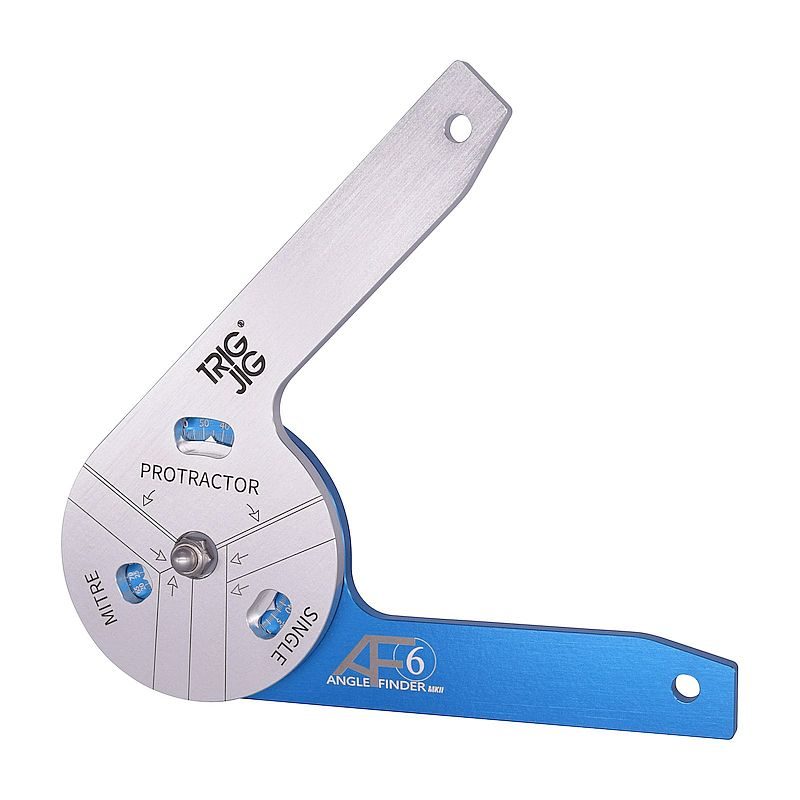
Woodworkers, finish carpenters and tradespeople who value a durable, battery-free tool for rapid angle transfer and repeatable layout should love the AF6.
An angle finder (also called an angle gauge, site protractor or miter protractor) is a small measuring tool that helps you measure internal or external angles and then transfer those angles to saws or templates. This is the tool of choice for a variety of jobs:
- Measure wall/trim angles for coping, baseboard or crown moulding.
- Find the exact bevel or miter to set on a miter saw or table saw.
- Check angles on brackets, stairs, rafters or existing work to reproduce them.
- Lay out compound or butt joints where two pieces meet.
There are two broad families: mechanical/analog angle finders with engraved scales and pointers, and digital/electronic inclinometers that give numeric readouts with greater numeric resolution and sometimes magnetic bases and backlights.
The TrigJig AF6 MKII is a mechanical/analog style of angle finder. Lets have a look at what it offers.
Manufacturer: TrigJig Tools
Model: AF6 MKII
Price: $79US plus $15US shipping – about $130 CAD
Made in: UK
Warranty: lifetime
Source: TrigJig Tools
Key features:
- 6″ arms
- CNC-milled from 6mm T6 6082 aluminum plate
- Laser-engraved with markings every 1° ( ±0.25° accuracy)
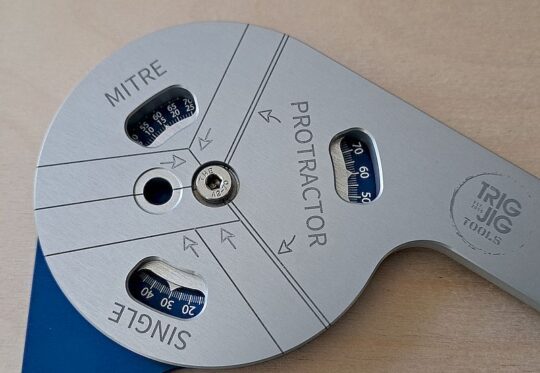
- 3 display windows: protractor angle, miter angle and single butt joint angle.
- Available in 7 colour schemes
The TrigJig AF6 MKII is a precision, all-mechanical angle finder — a pocketable, CNC-machined protractor that quickly provides protractor, miter, and single-butt-joint readings for carpentry, trim, joinery, and on-site layout work. Built for repeatable, tactile measuring rather than electronic readouts, its strengths lie in durability, simplicity, and a triple-display layout that speeds the transfer of angles to a miter saw or gauge.
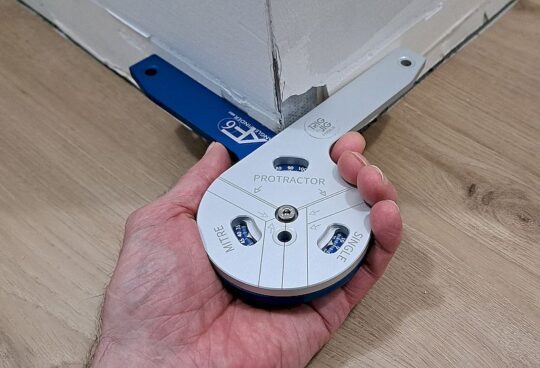
The AF6 has dual 6″ (152 mm) arms, long enough for good centering and leverage yet compact enough to fit in a pants pocket or tool pouch. Holes in the end of the arms enable you to suspend the angle finder on a nail or hook.
Its triple display shows protractor, miter (saw-style), and single-butt-joint scales on the face of the tool, so you can read the angle in the format you need and transfer it directly to a saw fence or miter gauge.
CNC-machined from ~1/4″ (6 mm) T6 6082 aluminum, the AF6 features an anodized finish available in seven color combinations. The markings are laser-engraved at 1° intervals, with locating arrows positioned close to the scales to minimize parallax errors. My eyesight isn’t perfect, and I find the markings — along with the display windows, at roughly 3/8″ × 5/8″ — a bit on the small side. In less-than-ideal lighting, I often reach for my headband magnifier. Larger windows might allow the markings to be increased in size for easier reading.
A standout feature is the 45° block scale. On most miter saws, the fence and table geometry limit you to a maximum miter setting of about 45–60° from square. That’s fine for most joints, but sometimes you need an acute angle. Using a 45° block of wood (sometimes called a miter block or triangle) against the saw’s fence lets you rotate the workpiece to achieve cuts beyond the saw’s built-in range. It’s a small feature, but if you work with tricky trim layouts, irregular framing, or decorative angles, it saves a lot of trial and error. On the AF6, the 45° block graduations appear alongside the regular miter graduations in the same Mitre window, so you can quickly choose the appropriate scale depending on whether you’re cutting directly against the fence or using the 45° block method.
Another useful enhancement on the AF6 MKII is the QR code crown moulding angle generator. Scan the code on the back of the tool, enter the wall angle (where the ceiling meets the wall) and the spring angle (how far the moulding tilts away from the wall), and you’ll instantly get the calculated miter and bevel settings.
In use? The AF6 performs exceptionally well. The triple display eliminates conversion steps, speeding up repetitive layout work. The long arms help hold the tool steady, while the machined aluminum and laser-engraved markings make it rugged and virtually maintenance-free. It shrugs off normal jobsite impacts, resists damp conditions, and requires no batteries or delicate electronics. The 1°-increment scale and precise locating arrows are more than adequate for almost any task.
At around $130 CAD ($79 USD plus about $150 shipping), it’s competitively priced for such a high-quality, fabricated tool.
The TrigJig AF6 MKII is a thoughtfully designed mechanical angle finder that prioritizes readability, durability, and ease of transferring measurements to saws and joinery. While it won’t replace a high-resolution digital inclinometer for sub-degree precision, for everyday woodworking and site layout its triple display, solid machining, and 1° laser-engraved scales make it a fast, dependable, and cost-effective choice. If you value tactile reliability and quick transfers over electronic extras, the AF6 MKII is among the best mechanical options available.