TIPS & HOW TO
Barn board

James Jackson
There are few things in the woodworking and DIY world better than the charm and warmth of a refinished barn board project.
There are few things in the woodworking and DIY world better than the charm and warmth of a refinished barn board project.
Whether it’s a rustic entryway bench or floating shelves made of century-old beams, the appeal of barn board has had some real staying power over the decades.
My in-laws bought their house more than 35 years ago in a quiet farming community and requested the builder install a custom wooden mantle over the fireplace made of a beam from the old barn that once stood nearby. To this day, it’s a beautiful piece that still has stockings nailed into it every Christmas as if it were from a Charles Dickens novel.
And when my parents built their first home decades ago, my dad covered some of the walls in the basement with barn board – then confided to us years later that some of the boards were actually attached upside down, since the brown rust marks from the nails ran upward toward the ceiling instead of down to the floor.
And today you can hardly walk into a bar, hamburger joint, coffee shop or realtor’s office without seeing the creative flair of reclaimed wooden tables, countertops or accent walls.
I have to ask though – is the barn board boom in danger of waning? Or does the rustic look transcend time?
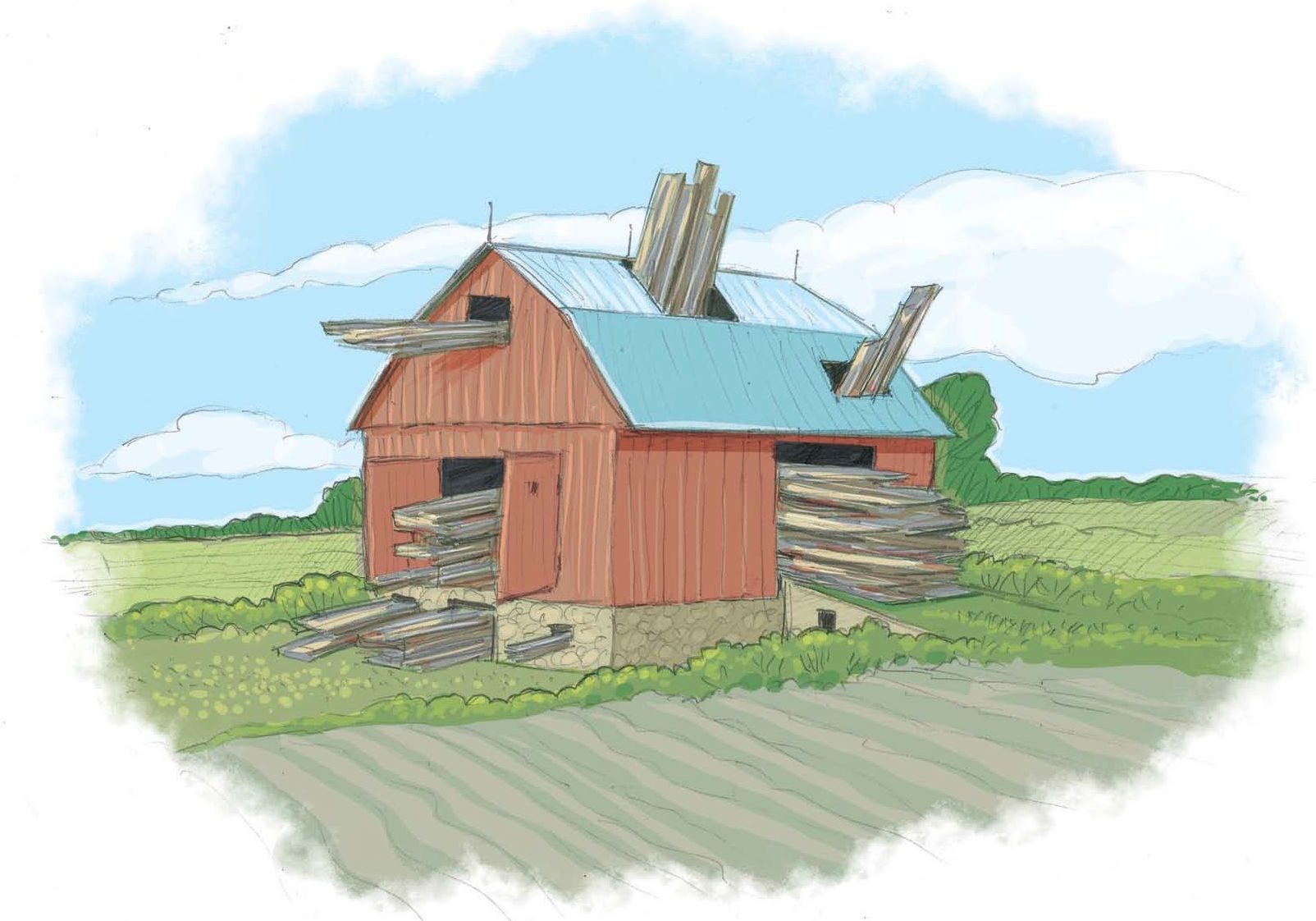
I’m asking mostly for selfish reasons, after spending countless hours salvaging, sorting, de-nailing and stacking hundreds (perhaps even thousands) of board feet of barn board over the past few years. Together with my dad, we’ve stacked, unstacked and re-stacked these boards onto skids and placed them under cover inside the hay barn.
All of this hard work hinges on the continued appeal of barn boards for building projects, and we’ve got a wide variety to choose from. There are boards well over 12′ long, short boards, fat boards and skinny boards. We’ve got two-inch thick threshing floors along with barn beams, rafters and support struts. There’s not quite enough to build an entirely new barn, but probably pretty close.
In fact, there’s so much that we’re now running out of space to store it all. I’ve even floated the idea of actually selling some (a thought I never could have imagined just a few years ago). And this stuff is valuable. A quick search online reveals some salvage companies are selling reclaimed wood for prices ranging from just a couple dollars per board foot for unfinished material straight from the scrap heap, up to $10 for milled and de-nailed stock that’s ready to go for whatever project you need it for.
The barns, drive sheds and old factories that are the most common sources of this material are becoming rarer by the year as they disappear due to age, wear and tear, and the seemingly unstoppable progression of our towns and cities onto prime farmland.
I love working with the stuff, aside from the occasional stray rusted nail that can chip a blade in your jointer and planer, but it’s also one of the more difficult materials to build with. The wood tends to warp and twist as it ages, and a lot of the outer barn cladding is less than an inch thick, meaning if you were to try and flatten the twists you’d be left with very little (if any) wood to work with.
A lot of it is rotted and cracked, too, rendering it unusable for some projects.
I used to scrounge and save every scrap I could find, thinking to myself, “That could be a sign, bottle opener or candle holder,” but I’ve evolved into a more discerning woodworker in recent years. In other words, I’ve come around to the idea that some of it just isn’t good for anything. A lot of it is downright garbage.
So, while my dad was away on a long road trip this past summer, I took the opportunity to become ruthless in my barn board sorting and I picked out the worst of the worst and relegated these boards to the burn barrel. The resulting fire was hot, as the dry wood burned quickly.
I have to admit, though, that while I tossed the pieces into the barrel, I couldn’t help but save a few and carry them back up to the barn for safe keeping. Old habits die hard.