TOOLS
Festool aftermarket accessories: track saw blades

Carl Duguay
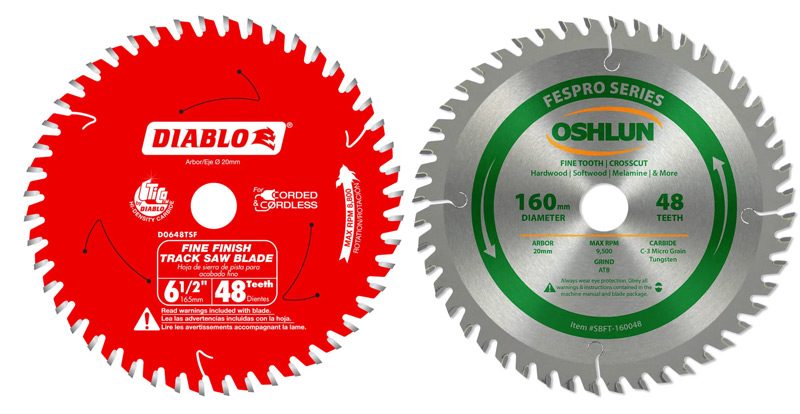
These budget‑friendly blades deliver quality and longevity comparable to Festool originals, offering excellent value for the price.
Festool’s saw lineup — including track saws like the TS 55 and TS 75, and the HKC 55 circular saw — are fantastic out of the box. Aftermarket blades are one of the easiest upgrades, with options optimized for ultra-fine finish cuts, cross-grain cuts, or ripping. I’ve found that some premium blades can deliver excellent quality and longevity comparable to would expect from original Festool blades.
Manufacturer: Diablo
Model: D0648TSF
Price: approximately $48.00
Source: Dealer locator
Manufacturer: Oshlun
Model: SBFT-160048
Price: approximately $38.00
Source: Amazon.ca
When you own a Festool track saw, one of the first things many woodworkers explore is alternative blades. Festool’s factory blades are excellent, but there are also several well-designed aftermarket options that can deliver comparable performance at a lower cost.
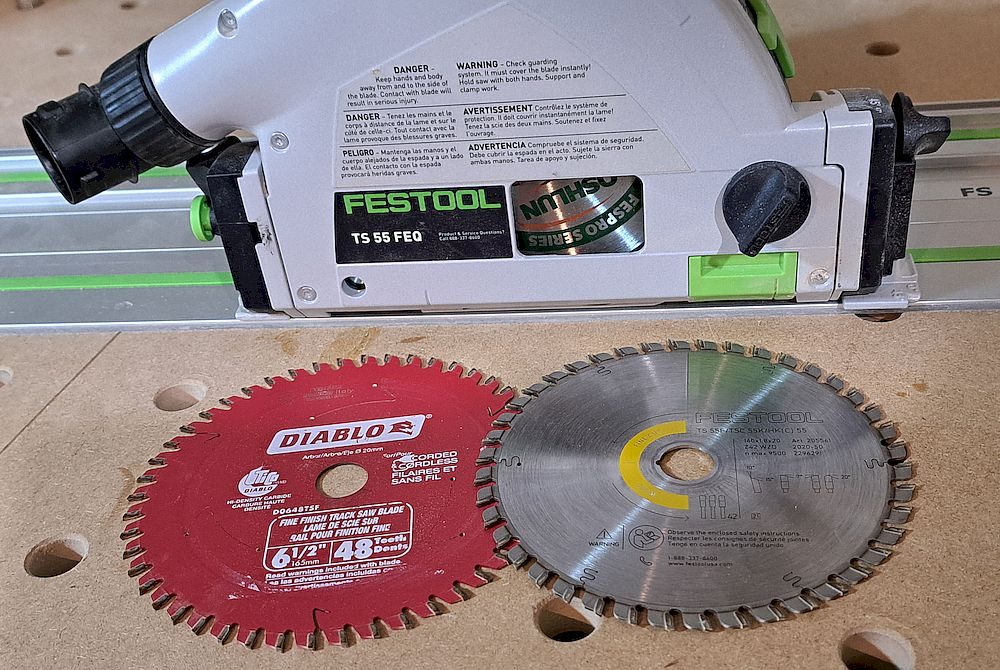
Two blades that I’ve tried out are the Diablo D0648TSF and the Oshlun SBFT-160048. Both are designed as fine-finish blades for 160 mm track saws and can be used as replacements for the stock blades supplied with most Festool plunge saws.
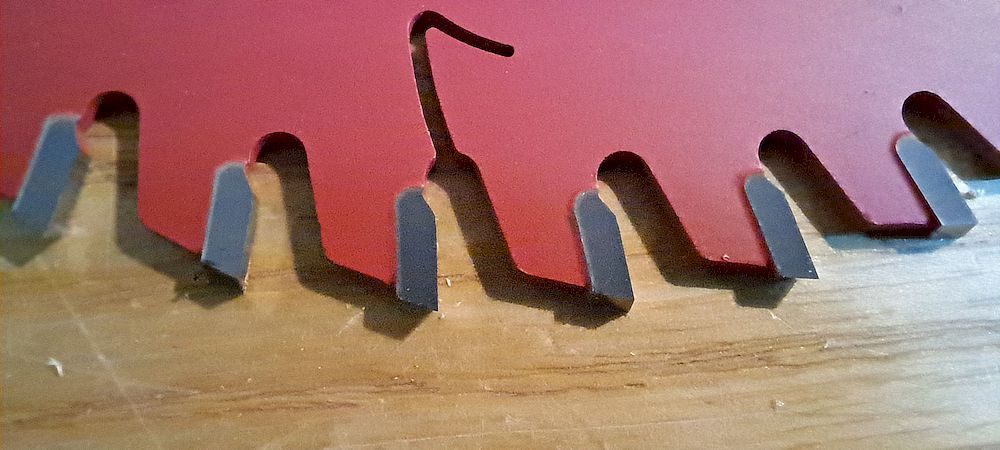
Diablo D0648TSF track saw blade
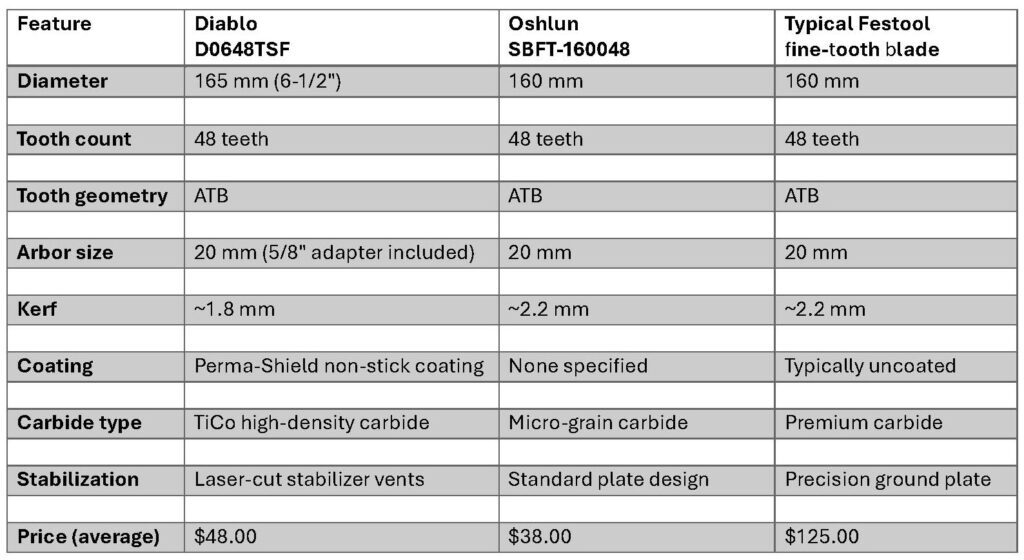
The Diablo D0648TSF is a 6-1/2″ (165 mm) blade designed specifically for track saws. It uses a 48-tooth Hi-Alternate Top Bevel (ATB) tooth pattern, which is well suited for clean crosscuts in hardwood, plywood, MDF, melamine and other sheet goods.
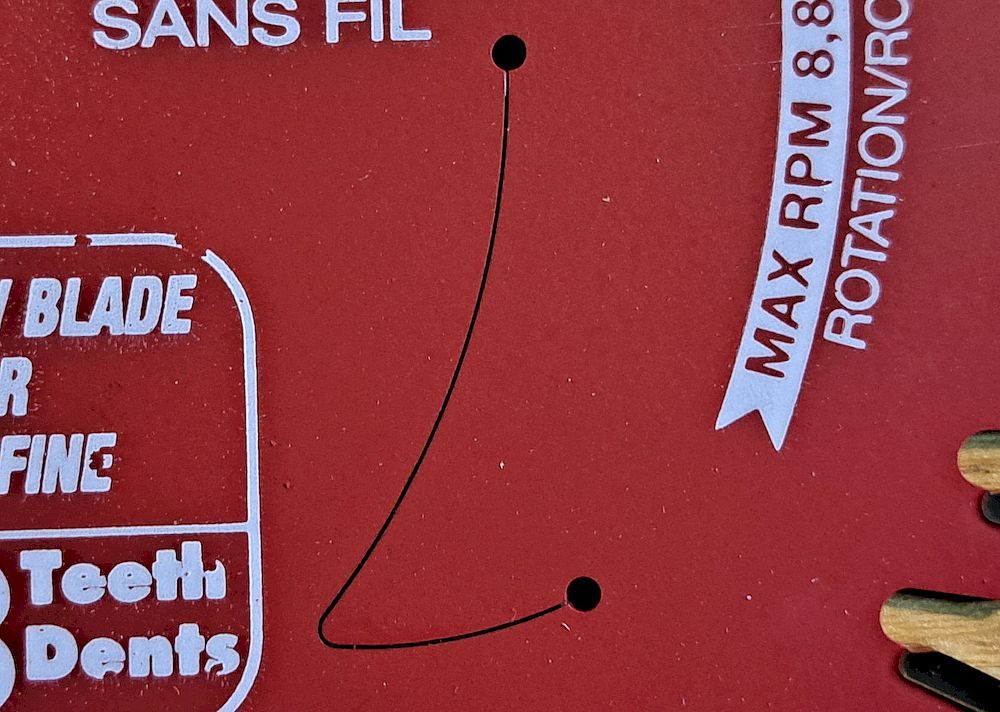
Diablo uses its TiCo high-density carbide teeth, which are engineered to maintain sharpness and resist wear in demanding cutting conditions. The blade also incorporates laser-cut expansion slots to reduce heat buildup and stabilizer vents to stabilize the blade body and reduce vibration during cuts, helping maintain accuracy when plunging through sheet materials.
Another notable feature is Diablo’s Perma-Shield coating, a non-stick surface treatment that reduces pitch buildup and corrosion while lowering friction during cutting.
Key specs include:
- Diameter: 6-1/2″ (165 mm)
- Tooth count: 48
- Arbor: 20 mm (with adapter bushing for 5/8″)
- Kerf: approximately 0.07″ (about 1.8 mm)
- Tooth grind: Hi-ATB crosscut pattern
Because of the 20 mm arbor and track-saw-specific geometry, this blade can be used with the Festool TS 55 and TSC 55 track saws and the Festool HKC 55 EB circular saw.
Oshlun SBFT-160048 FesPro saw blade
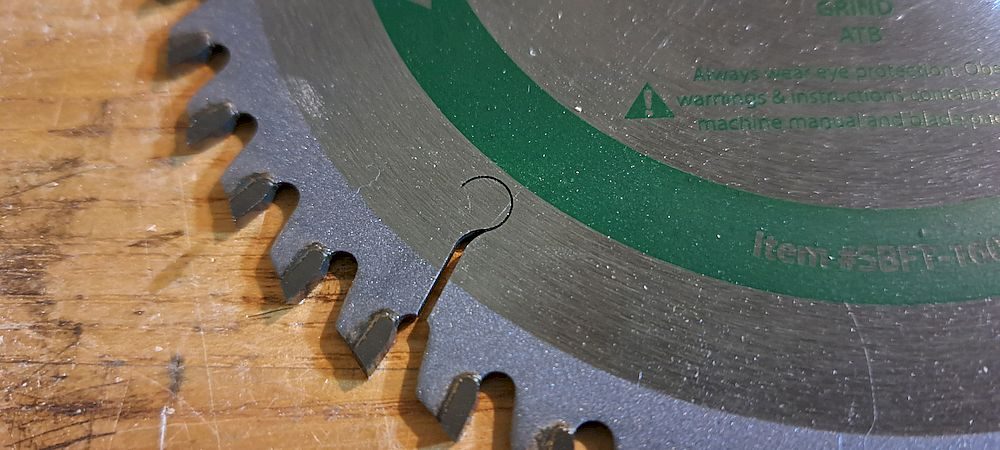
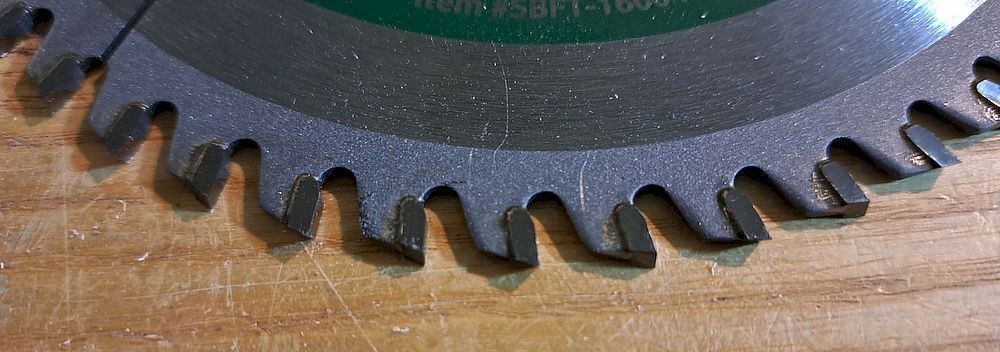
The Oshlun SBFT-160048 is part of Oshlun’s FesPro series, which is specifically designed as a direct replacement blade for Festool plunge saws. It has a 160 mm diameter with a 20 mm arbor, matching the standard configuration used by Festool track saws, so that it integrates perfectly with the saw’s riving knife and guide rail splinter guard.
Like the Diablo it features a 48-tooth blade, but with a standard ATB grind and four expansion slots that help cool down the blade in use.. Oshlun uses micro grain tungsten carbide teeth that provide a good balance between hardness and toughness. Unlike the Diablo, the blade does not have an anti-stick coating.
Key specs include:
- Diameter: 160 mm
- Tooth count: 48
- Arbor: 20 mm
- Kerf: approximately 0.087″ (about 2.2 mm)
- Tooth grind: ATB crosscut pattern
The blade is designed to work with the same Festool plunge saws as the Diablo blade.
Comparison with stock Festool blades
Festool’s factory fine-tooth blade — often supplied with the TS-series saws — is a 160 mm blade with 48 carbide teeth and a 2.2 mm kerf, designed for clean crosscuts in solid wood and veneered sheet goods.
From a design standpoint, the Diablo and Oshlun blades share many of the same characteristics:
1. Tooth geometry: All three blades use an ATB tooth pattern, which alternates left and right bevels to slice wood fibers cleanly. This geometry is ideal for plywood, melamine and hardwood crosscuts.
2. Diameter and arbor compatibility: Festool track saws typically use 160 mm blades with a 20 mm arbor — both the Oshlun and Diablo are manufactured to this specification.
3. Kerf differences: Festool blades generally use a 2.2 mm kerf, while the Diablo uses a slightly thinner kerf. In use I found that it didn’t require recalibrating the splinter guard on the Festool guide rail.
4. Price and positioning: Festool blades are typically positioned as premium OEM accessories with very tight manufacturing tolerances. Both the Diablo and Oshlun blades are more affordable alternatives, costing noticeably less while still delivering good performance for most woodworking tasks.
My observations
From a practical standpoint in the shop, both the Diablo and Oshlun blades perform very well in a Festool track saw. The Diablo blade distinguishes itself with its friction‑reducing coating and anti‑vibration design, while the Oshlun blade appeals to users who want a Festool‑style replacement at a more accessible price.
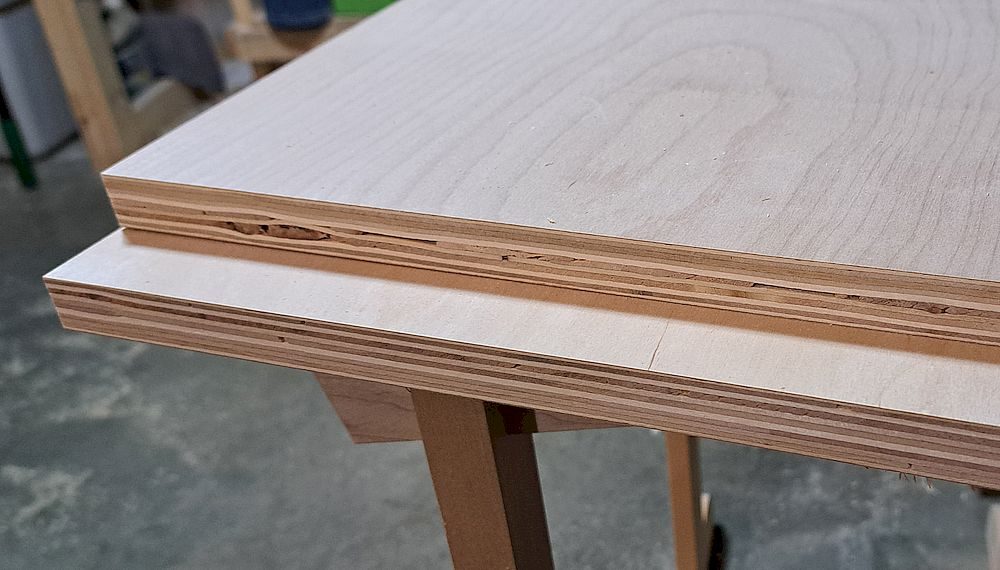
In use, the Diablo produced an excellent finish on plywood, shop‑made veneered panels, and hardwood. Its slightly thinner kerf reduces cutting resistance, which can help extend battery runtime on cordless saws. The Perma‑Shield coating also contributes to smoother cutting by reducing friction and resisting pitch buildup, which in turn can support longer blade life during heavy use.
The Oshlun blade delivered impressively clean crosscuts and rip cuts in plywood, melamine, and hardwood, with a finish that was nearly indistinguishable from the Diablo. I had expected the Oshlun’s standard ATB grind and the Diablo’s high‑density carbide to create a more noticeable gap in cut quality, but early results showed only a marginal difference. Over time, however, the Oshlun’s teeth have begun to dull a bit faster than the Diablo’s. Overall, it strikes me as a solid choice for general‑duty work and for anyone watching their budget.
For most hobbyist woodworkers, the differences in cut quality between these blades and the stock Festool blade are subtle. The more meaningful distinctions tend to be longevity, sharpening life, and price rather than dramatic differences in surface finish.
In practice, it’s worth keeping a couple of blade types on hand — one for general sheet‑goods work and another reserved for critical finish cuts. Whether you choose Diablo, Oshlun, or the original Festool blade, the key is matching the blade to the material and maintaining it properly so your track saw continues to deliver clean, splinter‑free cuts.
The Festool OEM blade still sets the benchmark for manufacturing tolerances and consistent cut quality. Because Festool designs its blades specifically around the plunge‑saw geometry, riving‑knife clearance, and guide‑rail system, many professionals continue to prefer them for the most demanding finish work.
Will they work with the Festool CSC SYS 50 cordless table saw?
The short answer is “yes, but…”. The longer answer is “no, and here is why”.
The Festool CSC SYS 50 uses a blade diameter that differs from most Festool track saws — specifically a 168 mm blade. It’s the same blade size used by the Festool TS 60 KEB and TSV 60 KEB track saws, and Festool explicitly confirms that TS 60 blades are compatible with the CSC SYS 50.
Although the arbor size is the same at 20 mm, the Diablo blade is 165 mm — 3 mm smaller than the required diameter. Using a smaller blade reduces maximum cutting depth (even if only slightly), can cause the blade to sit out of alignment with the riving knife, and may create compatibility issues with the blade guard, splinter guard, and the saw’s internal safety calibration.
The Oshlun blade at 160 mm is even further outside the intended spec. It would result in a more noticeable loss of cutting depth, improper riving‑knife alignment, and increased safety concerns.
Because the CSC SYS 50 relies on a precisely matched blade diameter, kerf, and riving‑knife geometry, it’s best to use only 168 mm blades.