FROM ROB'S BENCH
Material selection: weighing the pros and cons

Rob Brown
Blog for June 20, 2024
I’m just about to design and build an entryway storage unit near one of our entry doors.
The door enters into an area of the basement, which will be full and more utilitarian than beautiful. It’s the typical entryway for all my family, though visitors almost always come to the main front door.
Everything from a small bench to sit on, lots of hooks for jackets, shelves for a wide range of footwear, and cubbies for small items like mitts, gloves and bike helmets will be included in the design.
What are our needs?
I want the unit to look good, but I don’t need it to look great. But even more important than how it will looks is how it will function, followed by ease of upkeep. Keeping the cost down and not taking forever to build and install are also pretty high on my list.
The storage unit will likely get banged up a bit and regularly need to be cleaned of dirt. I’d like to say it’s going to be the kids that will do most of the cleaning, but to be honest, I think we’re all going to participate equally.
Material selection
The design will be taken care of by my wife and I. She has a good idea of the stuff we need to keep there, as well as how to store these sorts of things, and I have a keener eye for material use, dimensions, construction details, industry standards and the like. It won’t be hard for us to work together to come up with a design.
I’ve been wrestling with material selection, though. Part of me wants to use veneer-covered plywood. On the “pro” side, it’s strong, looks good and comes in a variety of species. On the “con” side, it needs to have a finish applied, which slows the whole process, and it’s more expensive than other options. Nothing in me wants to use solid wood for this project. Although it could turn out to be beautiful, the labour and expense far outweigh any final good looks it would have.
The other option is melamine. In the “pro” column, it’s surprisingly durable and doesn’t need to be finished, which speeds up the whole process. Both of these are huge pros for this specific project. On the “con” side, it doesn’t look great (though thankfully it doesn’t look awful). Considering speed and durability are high on my list, I’m leaning towards melamine, even though a part of me thinks I should use a more attractive material.
Time to choose
At the end of the day, there’s a time and a place for materials of all sorts. Solid wood has its place, and is a crowd favourite, but it’s certainly not for every situation. Some people think sheet goods should be reserved for workshop jigs and storage only, though I don’t agree with that stance. Like every material, sheet goods have their pros and cons, and each should be evaluated carefully before making a purchase. I even have construction-grade plywood holding up some bikes in another area of this room, so that will give you an idea of how high-end this space is.
While white melamine is super clear and bright, I’m leaning towards a classic maple melamine surface, as it will hide the dirt better and won’t be as stark and bright as white. There are other colours available, but the retailer I deal with only has easy access to white and maple.
Practicality might very well have me going with a material that some people would find sub-par for this (maybe even any) job, but I’m liking the pros it has to offer. A quick and easy build, followed by a decent amount of durability is what this project is all about. If all goes well, I’ll be sharing some photos of the finished project next week.
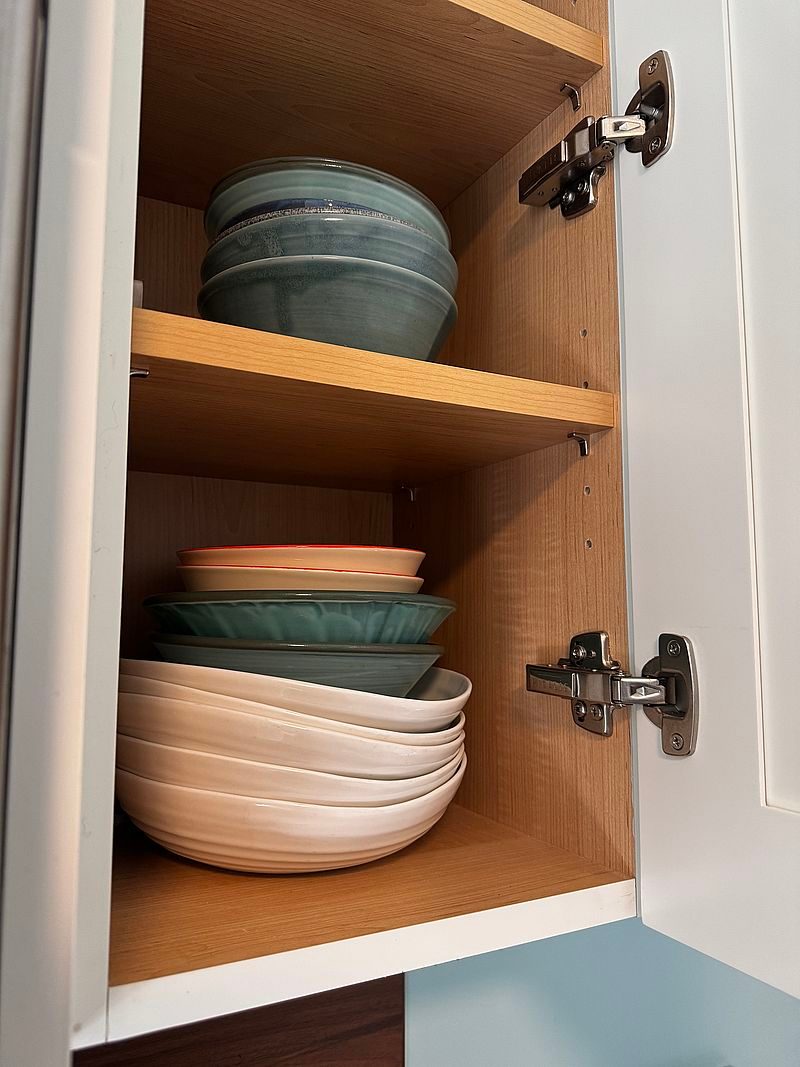
Classic Maple Melamine
This is the interior of one of our kitchen cabinets. The boxes are constructed from maple melamine, while all show surfaces, including the doors, are white. It’s a durable approach that looks and functions nicely, without breaking the bank.