
FROM ROB'S BENCH
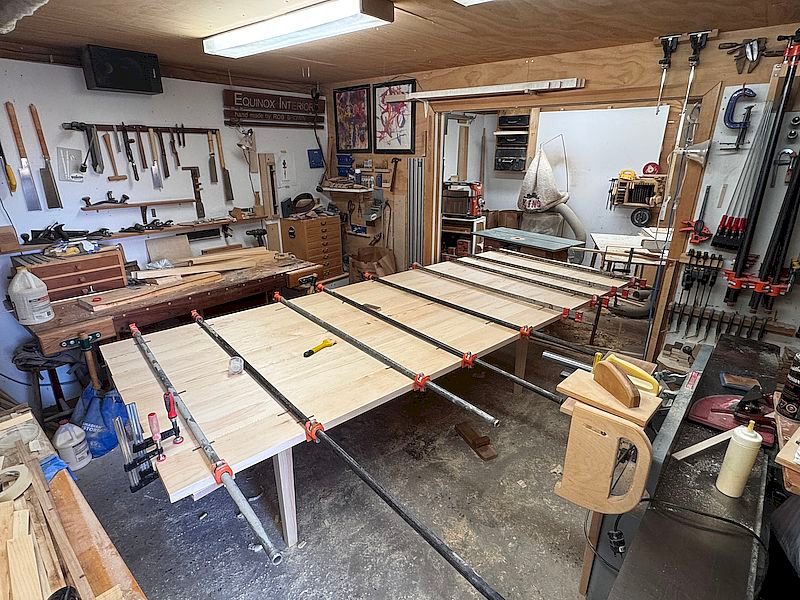
Big job in a small shop

Rob Brown
Blog for October 2, 2025
Last week, I mentioned a large dining table I've been working on.
Thankfully, it’s provided me with a great excuse to put aside my to-do list for the time being. Paying customers take precedence, after all.
What is it, this time?
There’s always some sort of a challenge with the work I do. Whether it’s a unique wood that’s tricky to work with, a client who doesn’t really know what they want, but knows what they dislike, or a technique that pushes my boundaries, I usually have to jump through a hoop or two. The challenge with this job is the overall size of the dining table, especially the top. It will finish just over 11′ long and just under 5′ wide. Certainly not impossible, but there are challenges that come with making a top this large.
The first challenge
First of all, how hard would the material be to obtain? This was a pine table, but the client wanted it as clear as possible. The top was to finish at 1-1/4″ thick. I made a few calls, then hit the road to see some of the options with my own eyes. The first lumberyard I went to had the length and thickness I was after, but the grade wasn’t up to par. Too many knots meant I had to press on.
The second place I went to had some beautiful, clear 6/4 stock that was all 14″ long and 8″ wide. That meant I needed no less than seven pieces to make this top, along with some shorter pieces for the base. We went to the back to check it out. I couldn’t believe what I saw; seven planks this size that were all virtually perfect. It was beautiful stuff and they had the perfect number of planks, too. Almost weird, but I wasn’t complaining.
I had them trim the planks to rough length, grabbed a few other boards, then loaded up my vehicle. Luck was on my side.
The main challenge
When I had this material in my shop, I started to get serious about the next challenge. How could I machine these boards straight and true so they could all be edge-glued? I’ve used a track saw to trim a straight edge on a long board before, but my track is only 8′ long. There was also the challenge of jointing a face, before the boards could be thickness planed.
First, I had to rearrange my shop so I could have 11′ on both infeed and outfeed sides of my 8″ jointer. The jointer had to remain within striking distance of the only 220-volt plug in my shop and the cord isn’t all that long. The width of my shop is 16′, while the length is well over 20′. I just can’t move the jointer far enough away from the plug to give me 11′ between the jointer and the plug. I was able to move my jointer to a spot near the double doors to give me about 12′ on the far side of my jointer and open air on the infeed side.
Thankfully, these boards were fairly flat and straight, though they were still far from perfect. Lifting them around the shop wasn’t impossible, though I must have nearly knocked half of my tools and jigs off the walls while working on this table. By the end of the afternoon my biceps were pretty sore, but all of the planks had been jointed and planed to just over final thickness. I won’t bore you with having to run the boards kitty corner inside my shop in order to be able to keep the dust collector hooked up to the planer and still have enough room to maneuver these boards into and out of the planer.
Now the hard part
I still didn’t know how straightening one edge would go. I decided to give the jointer a try, mainly because it was still in the perfect position to allow me enough room on either end to machine these long boards.
First, I had to set up an outfeed support to assist with keeping the distant end of each board from dropping down as I finished the pass. Starting on my table saw’s outfeed table, I used a piece of 1/2″ plywood as a ramp and shimmed the outfeed table to bring the piece of plywood up to the right height. Some trial and error helped me refine the height.
To my surprise, this approach worked pretty well. I was able to apply enough pressure on the leading end of the board to keep it in contact with the rotating cutterhead, the middle section was obviously easy, and the outfeed support worked nicely, too. Between one and two passes was all these boards needed to give me a straight edge.
Next up, rip to width
At this stage I had two dressed faces and one dressed edge. My table saw, equipped with some outfeed support, was the next step. Before I could turn it on, I had to move it about 4′ away from the distant wall and angle the saw about 20°. This provided me with enough room on the outfeed side of the saw, while the infeed side of the saw was aligned with my double doors. I was thankful it was warm and dry outside.
Grab the glue
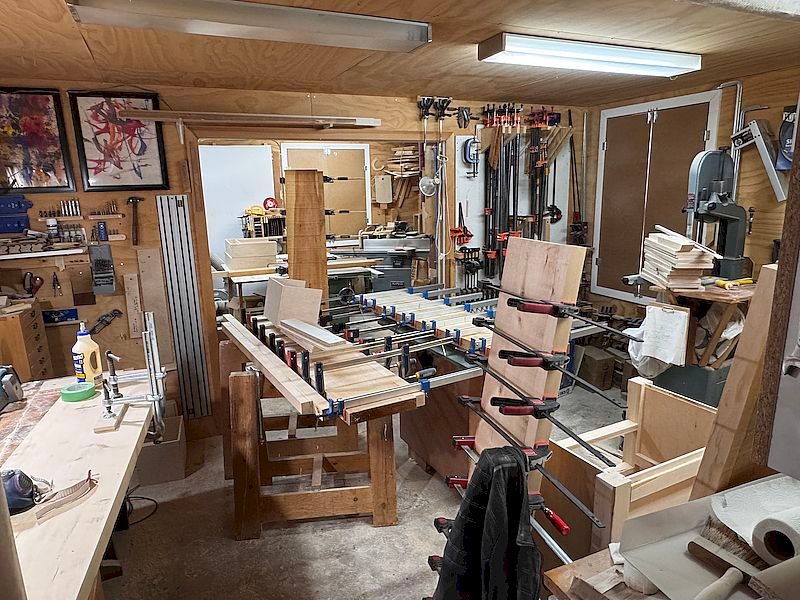
One-by-one, I glued up the planks. Each 11′ long joint had three Dominos in it to help align the mating boards. When you’re working by yourself, you have to stack the deck in your favour, especially when working with long boards. The first two went together easily. The next few needed a tiny bit of fine tuning with a hand plane to bring the two boards together nicely, but that only took me a few minutes each time. The last few boards were starting to get a bit trickier, as the main blank I was assembling had less and less flex to it. Still, with four or five minutes of hand planing I was able to create a nice edge to keep the joint strong for centuries.
It took me most of the day to bring all the boards together, but at least the task was complete. Now I had another challenge, moving the top so I could continue working on it. It wasn’t overly heavy. Likely about 100 pounds. It was quite large though, at 11′ by about 5′. These factors made it dangerous to move alone, but thankfully my daughter was dropping by the shop to make a small project for someone, so I waited patiently for her to arrive. After about five minutes of going over the plan, we were able to move the top and flip it over so I could continue working on it. I still have to shimmy past it sideways in some areas, nor do I know how I’m going to deliver this huge top, but that’s a challenge I’ll consider in a few days.
The current challenge is coming up with a stain colour the designer likes, which I know is going to be quite the process. This, coupled with the fact that the future owner of this table wants it in place before Thanksgiving weekend, isn’t keeping me up at night, but it is keeping me busy during the day. I should go mix up some stain options and make a few sample panels.
Just Enough Room
My small shop with a large project in it.
The Planks
Here's a look at the 11' long clear pine planks I've been working with.
Straighten an Edge
This is how I machined one straight edge on all of the large planks. A bit of planning goes a long way.



So good to see your videos of HOW you build your furniture – or furniture in general, particularly when there are unique challenges. Sure makes one wonder (and appreciate) how craftsman, 100+ years ago, built the quality furniture we see today and before today’s power tools were available.
Gotta love clear pine. Did you consider using a jointer plane instead of machining the pieces? If it were something like a relatively stout hardwood the machine would be your friend for sure, but I find pine planes by hand pretty painlessly. A big job in either case.
Hi Rob, This is a great project. I did a similar table 7 X 4 foot re-cycled pine. I sourced my lumber from a nearby 100+ year old church which was ‘modernizing’. It had knot holes and attractive scars (plus chewing gum). It turned out just fine. I used cross-struts to support the table width.
I used turned legs of pine
God bless you, Rob. You need a bigger shop – LOL
we all need bigger shops
Rob: You are amazing to make the table with such large dimensions in your crowded shop. I have made a coffee table in mine but nothing like the fiddling you have to do to make it fit. I’ll send you a picture of my setup separately. Cheers Ron
Great work and love seeing the videos. I am currently planning my shop, and considerations of length for large pieces are on my mind. Having mobile equipment seems to be the main advantage in a shop.