WOODWORKING TOp 10 LIST
Top 10 ways to amp up your router game

Carl Duguay
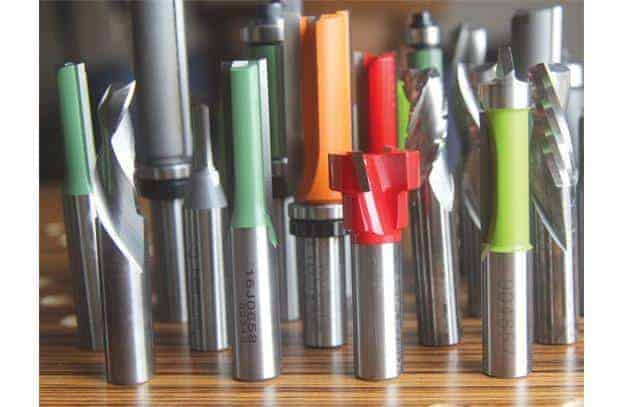
Routers are wonderful for profiling edges, but that’s just the tip of the iceberg. Learn about what they can do, make a few jigs, purchase a few additional items and you’ll be well on your way to increasing what you can do with these ultra-functional power tools.
1. Become familiar with all the things your router can do
Routers do much more than just edge profiling. Mortising, levelling, joinery, decoration and pattern making are just a few examples of the wonders awaiting you.
2. Get a router bit set
Without the right bit a router is pretty much useless. Buying bits one at a time is great if you only have the need for a few bits, but if you’re looking to expand what can be done with your router, start with a large set of router bits. Sure, many may never be used, but the cost savings are still substantial. And some bits you don’t know how to use now may be in regular rotation down the road.
3. Honing stone to sharpen bits
There are times when a bit needs to be properly and completely sharpened by a professional. There are, however, times when a few minutes spent with a small slip stone will add a bit of sharpness to a router’s cutting edges. Only hone the flat portion of the carbide or steel.
4. Ear protection
Everyone knows to wear eye protection while routing, but some don’t realize how important hearing protection is. Not only does it protect your hearing when the loud screeching is reduced, you’ll be able to better focus on the operation you’re undertaking, increasing safety and quality of cut.
5. Learn about different jigs
These may be the single quickest ways to expand the accuracy and functionality of what you can do with your router. Whether shop-made or purchased, jigs will turn your basic one-dimensional router into an ultra-functional workhorse that will do things you never thought possible.
6. Have jig parts around
Sometimes the biggest impediment to making a jig is not having the right jig parts around. Having hold-downs, handles, threaded inserts and many other jig-making parts ready for action will allow you to make a jig quickly and efficiently.
7. Consider a router table
Whether shop-made or purchased, a router table will instantly open up what you can do with your router, and also make operating it safer.
8. Buy template guides
Template guides are indispensable in so many routing operations. Having a few differently sized ones to choose from is handy, and they’re really not that expensive.
9. Buy a trim router
A trim router isn’t overly expensive (usually around $100, sometimes much less) and will allow you to work more quickly and accurately. They take only 1/4″ bits, and they won’t be able to hog off material like a full-sized router, but they are easy to manipulate and get into areas a full-sized router sometimes can’t.
10. Don’t go big right away
Unless you have the money, there’s no reason for your first router (or two) to be overly expensive. A plunge router kit can be had for a few hundred bucks. If down the road you feel the need for more functionality, you can always pick up another more powerful or capable router.