
FROM ROB'S BENCH
Learning the craft of woodworking

Rob Brown

Blog for June 27, 2025
Growing up, our family had a cottage on a steep lot north of Huntsville, Ontario. We spent virtually every weekend there, along with all our free time at Christmas, March Break and summer break.
We were on a lake, which was a lot of fun. My dad was a pretty handy guy. I spent a lot of time following him around, building decks and sheds and anything else that needed to be made out of made.
We had a home too, closer to Toronto, where we spent our weekdays. But we didn’t do a lot of work around our home. Sure, we cut the grass, shoveled the snow, planted annual flowers every spring and did a decent job at general upkeep, but we didn’t spend too much time or money on the house. The cottage was our focus, or at least my dad’s, who was the one taking care of small construction projects and general improvements.
Dad's little helper
I was always happy to follow my dad around, helping out when I could. I’d hold a flashlight while he shimmied under the cottage, I’d hold the funnel when he’d fill a boat gas tank and I’d hold the box of nails when he was making something out of wood. He didn’t so much teach me how to build something, but rather show my how he’s doing it today.
He was patient, but there was sometimes a “no, not like that … like this,” comment directed at me. I’d adjust the location of the flashlight beam as he asked, and off he went, further under the cottage.
Learning slowly
I slowly but surely learned a bit about DIY and woodworking tools, as well as the materials they were used on. Hammers and screwdrivers were easy, but jigsaws and circular saws were a bit too loud and dangerous for me early on. I eventually became more trustworthy and skilled and could be trusted to make a cut with a power saw. It wasn’t a very serious or intensive apprenticeship, but I enjoyed it. I think my father enjoyed the process too.
Getting more serious
When I was about 16 years old my parents bought a vacant lot on the neighboring lake and had a new cottage built on it. The lot was nearly perfectly flat and the plan was for my parents to retire at this cottage when the time came. With the cottage erected, we still had a lot of miscellaneous projects to take care of ourselves; two decks, a short run of steps out the back door and another one at the front door, a small shed, a pine tongue and groove living room ceiling, lots of interior trim to install and many other wooden items both indoors and out.
I helped and learned for a few more years. During those years I also spent more and more time in the high school wood shop, making a spice rack, a picture frame and a bunch of other wooden projects that quickly ended up on display at the cottage. It was a lot of fun.
Time for college
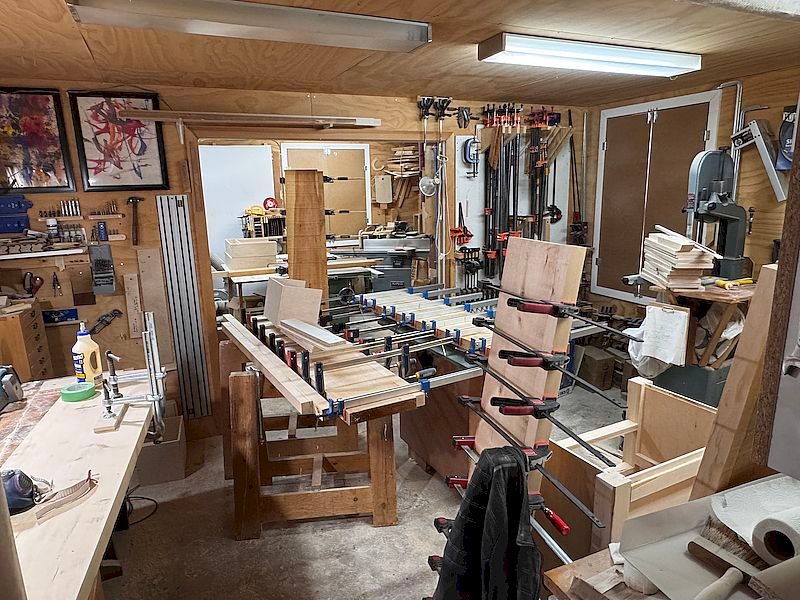
I eventually decided to head to college to learn more about furniture making. Conestoga College, in Kitchener, Ontario was about an hour and a half from our home, and they had a great 3-year program called Woodworking Engineering Technology. From day one, I loved it. Learning how wood moved with the seasons, what all the different tools and machines did, how to create amazing joints in wood and how to engineer lasting furniture was very exciting.
Before I knew it, I knew more about woodworking than my dad, which was pretty strange. All of a sudden, he was asking me how to make something and if there was tool to do this or that. He would call me down to his tiny basement shop to get my opinion on a method or a design, then we’d work together to get that joint accomplished.
Looking back
The first 19 years of my woodworking education went quite slowly. I learned bits and pieces of information, some of it was even correct, as my dad and I ticked jobs off his to-do list. During the next three years I learned an incredible amount of woodworking knowledge, which set me up for a life in furniture making and woodworking. Today, the internet has made learning woodworking easier, though the main drawback of that learning is that you don’t always know when someone is right and when they just think they’re right. If they sound sure of themselves, it can really be hard to tell the difference, and let’s be honest, it’s easy to sound sure of yourself if you want to.
The other advantage to learning today is that there are many trusty resources you can learn from. I’d like to think of the team at Canadian Woodworking & Home Improvement to be one of those trusted resources. We’ve now been around for 26 years and we have a large back catalogue of informative articles to choose from. And our past project articles cover just about anything you’d want to build.
Ramping it up
A short while ago our team realized how much informative articles we had in our vault and wanted to highlight them somehow. We also wanted to curate them so our readers could go through them one by one to learn the foundations of the craft of woodworking in their own homes. Over the past few months our senior editor Carl Duguay has been fine tuning our approach, which we’re happy to say is ready for woodworkers of all stripes. Beginners can obviously gain valuable and trusted knowledge about the basics of woodworking, setting them up to be successful woodworkers. Even intermediate woodworkers can fine tune their skills and knowledge, picking up bits and pieces of woodworking knowledge they missed the first time around. Whether you’re young or old, this is a great place to start (or continue) your woodworking journey.
Once you sign up, every week you’ll receive an email with new articles in it. Read through them at your own pace. Each week will be another email with a link to articles that will guide you through the process of honing your woodworking knowledge and skills. A lot of consideration has gone into the articles, as well as the order they arrive in your inbox in. These are building blocks and will answer woodworking questions you never knew you even had.
Try it out and let me know your thoughts. Our team would love to hear from you.
You can sign up for our free Woodworking Guide here.



This was refreshing to read !!